Best categories for Amazon wholesale: competition, margins and supplier depth
The best categories for Amazon wholesale are usually everyday consumables people rebuy: grocery, health and household, beauty and personal care, and pet supplies. No category is good on its label alone, though. Judge each on three checks: how crowded its listings are, your margin after Amazon's fees at its usual prices, and how many suppliers carry its brands.
- Everyday consumables are the classic wholesale categories. People use them up, buy them again, and rarely send them back.
- Competition lives on each listing, not in the category. Count the sellers who ship through FBA at the going price, and check whether Amazon sells the product itself.
- Amazon's referral fee depends on the category and the price. In some categories a cheaper item pays a lower rate, so the same profit math gives different answers.
- A category is only as good as the suppliers who will sell you its brands. Some sections of the Distributor Vault are deep and some are thin.
- Whether your account may sell in a category is a separate check, and our guide to gated categories covers it.
Read about wholesale for long and you'll see grocery, beauty and household goods recommended again and again. There's a reason for that. But a category label can't tell you whether a product will make you money. What it can tell you is the shape of the work ahead: how often customers rebuy, how crowded the listings tend to be, what Amazon takes from each sale, how many suppliers carry the brands, and which handling rules come with the products.
This guide goes through those five things for each category wholesale sellers usually look at, then shows you how to compare two categories with real numbers before you spend anything. Whether your account is allowed to sell in a category is a different question with a different answer for every seller. Our guide to Amazon gated categories covers it, so this page stays on the business side.
What makes a category good for wholesale
Wholesale means reselling brands that already sell on Amazon. You don't design the product or build demand for it the way a private label seller does. That's the appeal, and it's also why the category matters so much: most of what decides your results is already baked into the products you can buy.
In the Finding Suppliers lesson of Apex University, Stef explains why so many wholesale sellers end up selling everyday household brands. Few people return a tube of toothpaste or a bag of dog treats:
"These type of products have a very low return rate, meaning more profit is left behind in your business."
That's from Stef's lesson Finding Suppliers, at 0:58. His second reason follows straight after: these are consumable goods, so the customer who bought one is likely to buy again.
Amazon's own guide to finding wholesalers points the same way when it suggests you "zero in on profitable products with high sales volumes, healthy margins, or low competition." Put those together and you get five things to weigh in any category:
| What to weigh | The question to ask | Where to check it |
|---|---|---|
| Repeat demand | Do people use it up and buy it again, all year round? | Sales rank history on a handful of products (how to read a Keepa chart) |
| Competition | How many sellers share the listings, and is Amazon one of them? | The offers on each listing |
| Margin | What's left after Amazon's fees at the prices this category sells for? | The fee examples below, then your landed cost |
| Supplier depth | How many suppliers can sell you the brands? | The matching Vault section, and the competitors of any supplier you like |
| Handling rules | Expiration dates, heat, hazmat, size and weight | Amazon's rules for that product type |
Approval is a sixth question, and it doesn't fit the table because the answer changes with your account, the brand and the product, not just the category. Check the exact listing on your own account before you buy.
Competition: read the listing, not the category
The categories everyone recommends attract the most sellers. That doesn't make them bad categories. It means the work moves from picking a category to picking listings inside it.
The mistake new sellers make is counting every offer as a competitor. The ones that matter are the FBA sellers priced near the Buy Box; our Keepa chart guide walks through Stef's forty-seller example. Run that count on every product you sample in a category.
Three more things tell you how crowded a category really is:
- Amazon on the listing. When Amazon sells a product itself, it's a different kind of competitor. Our guide to products to avoid in wholesale covers how to spot it and when to walk away.
- Brands that control who sells them. Some brands limit online resellers or file complaints against sellers they didn't authorize. The gated brands guide and our guide to IP complaints cover what that looks like.
- A falling price. When the price on a listing slides month after month while the number of offers climbs, sellers are competing on price alone. A Keepa chart shows both lines at once.
Whoever wins the sale on a shared listing is the seller in the Buy Box, and our Buy Box guide explains how Amazon picks that offer.
Margins: Amazon's fee depends on the category and the price
Every sale pays Amazon a referral fee, and its rate is set by the product's fee category.
Here is the same price in two categories. At $12.99 in Grocery and Gourmet, Amazon's referral fee is $1.04, which is 8% of the price. At $12.99 in Home and Kitchen, Amazon's referral fee is $1.95, which is 15% of the price. Same price, same profit target, and one category leaves you noticeably more to work with.
Price lines matter too. In a few categories, Grocery and Gourmet among them, a product at or under a set price pays a lower rate than one above it, and the rate that applies covers the whole price, not just the part over the line. At $14.99 in Grocery and Gourmet, Amazon's referral fee is $1.20, which is 8% of the price. At $15.49 in Grocery and Gourmet, Amazon's referral fee is $2.32, which is 15% of the price. So a small price rise can cost you more in fees than it earns. Amazon's row shows where the line sits:
| Category | Referral fee | Minimum |
|---|---|---|
| Grocery and Gourmet | 8% at $15.00 or less; 15% above $15.00 | None listed |
- A product's fee category may not be the same as the category shoppers see in the Amazon store.
Source: Selling plans and pricing, Amazon
The referral fee is only one piece. The FBA fulfillment fee is set mostly by size and weight, with a price band on top (our guide to size tiers and fulfillment fees explains how), so on cheap or heavy items it can take more of the price than the referral fee does. Bulky products also cost more to store each month, which our storage fees guide covers. For the full list of rates by category, see our referral fees by category page.
Try your own prices here. Pick a category, type a price and see what Amazon takes:
Referral fee calculator
Item price plus any shipping and gift wrap the buyer pays.
Runs in your browser from Amazon's published US fee tables. Nothing you type is sent anywhere.
Fees are half the margin story. The other half is what each unit costs you to get to Amazon, and our guide to wholesale profit margins shows how to turn both into ROI and a margin you can compare across categories.
Supplier depth: who will sell you the brands
A category with great listings is no use if nobody will sell you the products. Supplier depth is easy to overlook, and it's the question that decides whether your business can grow past its first supplier.
In the Finding Suppliers lesson, Stef walks through how name brands reach a shelf: a manufacturer at the top, then redistributors that buy truckloads every week, then smaller distributors, then wholesalers, then retailers (Finding Suppliers, at 1:49). The practical point for picking a category is that a big household brand moves through many of these companies. That gives you more doors to knock on, a second price to compare, and a backup when one supplier runs out.
The Distributor Vault is sorted by category, so it gives you a quick read on where the names are. Here's how its sections compare by size:
| Vault section | Size, by listings | Amazon categories it mostly feeds |
|---|---|---|
| General merchandise | By far the largest | Many at once: variety, health and beauty, household and closeout distributors |
| Health and supplements | Mid-sized | Health and Household |
| Beauty and cosmetics | Mid-sized | Beauty and Personal Care |
| Grocery and food | Mid-sized | Grocery and Gourmet |
| Candy and snacks | Mid-sized | Grocery and Gourmet |
| Pet supplies | Small | Pet Supplies |
| Toys and hobby | Small | Toys and Games |
| Home and houseware | Small | Home and Kitchen |
| Office and school | A handful | Office Products |
| Cleaning and janitorial | A handful | Health and Household (household supplies) |
| Hardware and tools | A handful | Tools and Home Improvement |
| Electronics | A handful | Electronics |
| Outdoors and sporting | A handful | Sports and Outdoors |
| Apparel and fashion | A handful | Clothing, Shoes and Jewelry |
Read those sizes with care. They count listings, not companies, because a few companies appear twice. Some listings are stores, brands that sell direct or overseas companies rather than US distributors. And the Vault doesn't confirm that any company sells to Amazon resellers, so check each one's terms before you apply. A small section means our list is thin there, not that the category has few suppliers. Still, the shape is telling: outside General merchandise, most of the Vault's names sit in the everyday consumable categories.
When you find one supplier you like, look for its competitors in the same section. Our guide to wholesale suppliers covers how to vet them, and how to find brands to wholesale shows how to work back from a brand to the companies that carry it.
Runs in your browser, no sign-in, as often as you like.
Category by category
Each section below covers the same ground: why wholesale sellers like the category, what crowds it, what the fees look like at an example price, how deep the suppliers go and which handling rules to plan for.
Grocery and Gourmet Food
Why sellers like it. Amazon's own guide to selling groceries says "many grocery products are replenishable, with customers re-purchasing products they've enjoyed," and that this "can make groceries a great place to look for perennial bestsellers." Amazon also says: "Customers in the Amazon store purchased $100 billion in gross sales of groceries and household essentials in 2024."
Competition. National brands draw a crowd, because so many distributors carry them. Specialty and regional brands may have fewer sellers per listing, but they also tend to sell fewer units. That's a trade worth testing in your own sample rather than assuming either way.
Margin. Grocery has one of the lower referral rates for cheap items, as the examples above show. The catch is weight: drinks, cans and bulk packs are heavy for their price, so check the fulfillment fee before the referral fee.
Suppliers. Two Vault sections feed it: Grocery and food, and Candy and snacks. Many grocery wholesalers mainly supply supermarkets and restaurants, so look for packaged, shelf-stable brands.
Handling. Products with an expiration date have to arrive with enough shelf life left, and Amazon sets the minimum on its expiration-dated products page, which needs a Seller Central sign-in. Amazon's grocery guide also says "chocolate, yogurt, frozen produce, and other food that can melt or spoil requires special handling and shipping." Our guide to selling grocery on Amazon covers both, including the warm-weather window for meltables, along with approval and the labeling rules.
Health and Household
Why sellers like it. Toothpaste, vitamins, paper goods and cleaning supplies get used up on a schedule. This is the category Stef's toothpaste example comes from.
Competition. Big household names often have many sellers and sometimes Amazon itself. Supplements need extra care: they carry Amazon rules of their own on top of any approval, which our gated categories guide explains, and some supplement brands control who may sell them online. Ask before you buy.
Margin. Health and personal care products share a fee row with beauty, which has its own price line. At $9.99 in Beauty, Health, and Personal Care, Amazon's referral fee is $0.80, which is 8% of the price. At $10.99 in Beauty, Health, and Personal Care, Amazon's referral fee is $1.65, which is 15% of the price.
Suppliers. After General merchandise, Health and supplements and Beauty and cosmetics are the Vault's two biggest sections, and Cleaning and janitorial adds a few more names here. Several health names are retailers, and a store's receipt isn't a distributor's invoice, so know which kind of company you're buying from.
Handling. Amazon's list of everyday dangerous goods includes "Hand sanitizers," "Nail polish and mouthwash with alcohol" and "Dishwashing and laundry detergents." A hazmat product isn't always banned from FBA. Amazon says its dangerous goods team reviews these products to decide whether the inventory is safe for FBA, so check before you buy a case.
Beauty and Personal Care
Why sellers like it. Shampoo, skin care, cosmetics and razors are replenished, and most are small and light, which keeps the fulfillment fee down.
Low prices can still work if the products sell in volume. In the Purchasing lesson, Stef sets his minimum profit filter for one beauty supplier's price list at a dollar fifty a unit, and explains why:
"because I know PK Beauty sells lots of personal care items and they don't cost that much money, making a dollar fifty is not bad."
That's from Stef's lesson Purchasing, at 5:38. It was his filter for that one list, chosen because those items sell hundreds of units a month. It isn't a rule for every category.
Competition. Authenticity is the issue here. Buy only from sources that can show where the stock came from.
If a supplier sells salon or professional products, ask whether you may resell them online before you order.
Margin. The same fee row as health applies, price line included. Small items mean small fees in dollars, but on a low price every cent is a bigger share.
Suppliers. Beauty and cosmetics ties with Health and supplements as the Vault's biggest section after General merchandise: beauty supply wholesalers, perfume and fragrance wholesalers, nail and salon suppliers, hair distributors and a few stores.
Handling. Amazon's dangerous goods examples include "Perfumes and deodorant sprays" and nail polish, so fragrance and some cosmetics need a hazmat check. Many skin care products carry dates as well.
Pet Supplies
Why sellers like it. Food, treats, litter and grooming products get used up and bought again, and Stef's example of dog treats nobody returns comes from here.
Competition. Big national pet food brands draw the most sellers, as big brands do everywhere. Put smaller treat, grooming and aquarium brands in your sample too, and let the listings tell you which are quieter.
Margin. At $24.99 in Pet Supplies, Amazon's referral fee is $3.75, which is 15% of the price. Veterinary diets pay a higher rate. At $24.99 in Pet Supplies: veterinary diets, Amazon's referral fee is $5.50, which is 22% of the price. Big bags of food and litter are heavy, so the fulfillment fee and storage can matter more than the referral fee.
Suppliers. The Vault's Pet supplies section is mid-sized: pet product wholesalers, aquarium suppliers, a dropship service and a few online pet stores. Dropshipping is a different model with its own rules, which our reselling guide explains.
Handling. Pet food carries dates, so ask how much shelf life a case usually has when it ships. Amazon's dangerous goods examples include "Pet products like flea and tick controls," so check those before you buy a case. They're pesticides too, which our gated categories guide covers under restricted products.
Toys and Games
Why sellers like it. Toys sell all year, but demand peaks in the weeks before the winter holidays.
Competition. Sellers pile in for the holidays too. Look at last January on a Keepa chart for any toy you're considering, to see what happened to its price and offer count once the season ended. Buy for the season you can sell through, not for the one after it.
Margin. At $29.99 in Toys and Games, Amazon's referral fee is $4.50, which is 15% of the price. Toys can tie up cash for months, because you buy well before the rush.
Suppliers. The Vault's Toys and hobby section is mid-sized, with toy wholesalers, hobby and collectibles distributors, and a few toy companies that sell direct.
Handling. Before you buy for the holidays, read the toys row in our gated categories guide, which covers the holiday selling requirements other sellers report. Children's products also come with federal safety rules: the Consumer Product Safety Commission requires domestic manufacturers and importers of children's products to issue a Children's Product Certificate "based on test results from a third-party, CPSC-accepted laboratory." As a reseller you're usually neither, so ask your supplier for the certificate before you buy. Leftover stock after the season costs storage, so plan quantities with our guide to when to reorder.
Office Products and school supplies
Why sellers like it. Steady demand from homes and offices, plus a back-to-school spike you can plan a purchase order around.
Competition. The big office brands are widely sold, so put niche lines like art supplies or specialty paper in your sample too.
Margin. At $12.99 in Office Products, Amazon's referral fee is $1.95, which is 15% of the price. Many office items are cheap, so check the fulfillment fee as a share of the price.
Suppliers. This is one of the Vault's smaller sections, so look in General merchandise too. Many broad distributors carry office and school lines alongside everything else.
Handling. Few special rules for most products, which is part of the appeal. The exceptions are on Amazon's dangerous goods list, which includes "Office supplies like printer cartridges and strong glues." Plan the first order around back-to-school, not after it.
Home and Kitchen
Why sellers like it. It's huge. Amazon's own guide to Best Sellers lists uses it as the example of how to narrow down: "you might start with the Kitchen & Dining category, refine to storage and organization items." Much of it is bought once and kept for years, though, so repeat demand is weaker than in the consumable categories.
Competition. The range of brands is enormous, and some of them sell on Amazon themselves. Check who sells each listing before you chase it.
Margin. At $24.99 in Home and Kitchen, Amazon's referral fee is $3.75, which is 15% of the price. Size is the bigger risk. Bulky and heavy items move into more expensive size tiers and cost more to store, so check dimensions against the size tiers guide before you look at price.
Suppliers. The Vault's Home and houseware section is small: kitchen and housewares wholesalers, plastics and disposables, craft supplies and a cash-and-carry. General merchandise distributors fill the gap.
Handling. Amazon's prep and packaging guide says "Sharp items, fragile items, ceramics, and glass should be fully bubble wrapped instead of bagged," and items you sell together need packaging and a label that keeps them together as one unit. Our guide to FBA prep requirements covers the rest.
Baby Products
Why sellers like it. Diapers, wipes and baby food are consumables with very regular buying.
Margin. Baby Products has the same kind of price line as beauty. At $9.99 in Baby Products, Amazon's referral fee is $0.80, which is 8% of the price.
Suppliers. The Vault has no baby section, so look for baby lines in General merchandise and Health and supplements.
Handling. Baby food and formula carry dates. The gated categories guide covers which parts of the category other sellers report need approval.
Categories that look good and often disappoint
Trend products. A product riding a viral moment shows a spike in sales rank that looks irresistible. By the time a purchase order arrives and clears prep, the moment can be over, and you're left holding stock nobody is searching for. Look for steady sales rank over a year or more on a Keepa chart, not a single spike.
Electronics. The headline rate looks gentle, but accessories sit in a different row. At $59.99 in Consumer Electronics, Amazon's referral fee is $4.80, which is 8% of the price. At $19.99 in Electronics Accessories, Amazon's referral fee is $3.00, which is 15% of the price. Higher prices tie up more cash per unit, models change quickly, and anything with lithium batteries is on Amazon's list of everyday dangerous goods. Ask every supplier which brands it is authorized to sell before you look at its prices. The Vault's Electronics section is one of its smallest.
Clothing and shoes. Every product comes in sizes and colors, and each variation is its own product to research, buy and stock. Clothes that don't fit come back. Toothpaste rarely does. Clothing's fee bands also change sharply with price (shoes have their own row). At $14.99 in Clothing and Accessories, Amazon's referral fee is $0.75, which is 5% of the price. At $24.99 in Clothing and Accessories, Amazon's referral fee is $4.25, which is 17% of the price. The Vault's Apparel and fashion section has a single listing.
Anything fragile, frozen or fresh. If it needs cold storage, breaks easily or spoils, the product may be fine for a local store and wrong for FBA.
How to compare categories before you commit
Here's a way to test two or three categories with real numbers in an afternoon, before any money leaves your account.
- Start with what you can buy
List the categories your current or likely suppliers carry. A great category where nobody will sell to you isn't your category yet. If you don't have a supplier yet, start with the Vault sections that are deepest.
- Look at Amazon's Best Sellers in those departments
Amazon's guide to Best Sellers lists says "Amazon Best Sellers lists rank the most popular products in the Amazon store based on sales" and that "The lists are updated frequently." Look at each product's Best Sellers Rank to gauge demand, and note that some products have more than one rank if they appear in more than one category. Once you finish Apex University, our Chrome extension adds a line under each product on search results and Best Sellers lists, with monthly sales and either your profit or the most you can pay for your target ROI.
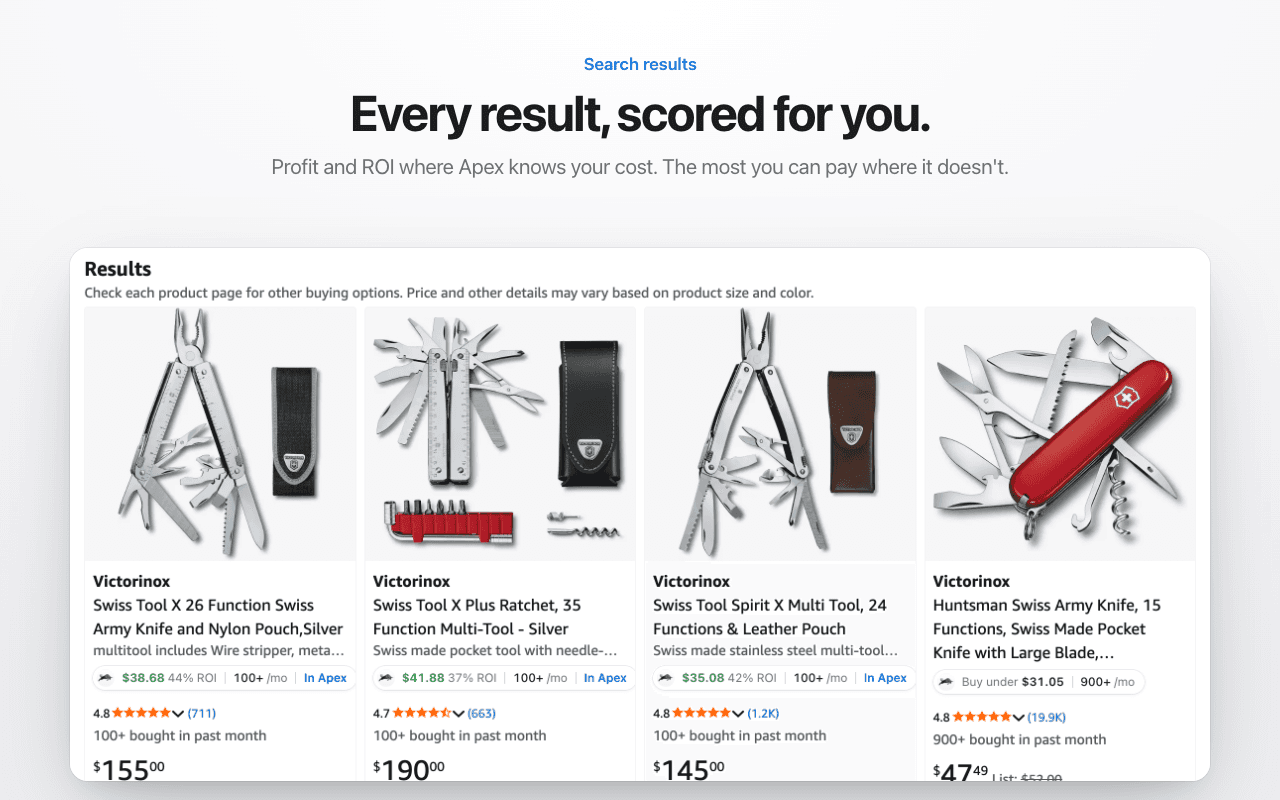
Badges under Amazon search results show monthly sales, and profit or the most you can pay, while you browse a category. - Sample real products from real price lists
Best Sellers shows you what sells, not what you can buy. So take a sample from supplier price lists in each category, 20 to 30 products as a rule of thumb, and run each one through the same checks.
- Record the same numbers for every product
For each product, note the FBA sellers at the competitive price, whether Amazon sells it, Amazon's fees at that price, your profit at your landed cost, and the monthly sales. Our guide to analyzing a wholesale price list walks through each check.
- Count the suppliers
For each category, count the suppliers you could realistically open an account with. One hard-to-reach supplier makes a fragile business.
- Check the products on your own account
Before you buy, search each product in Seller Central to see whether your account can list it. Our guide to gated categories shows how.
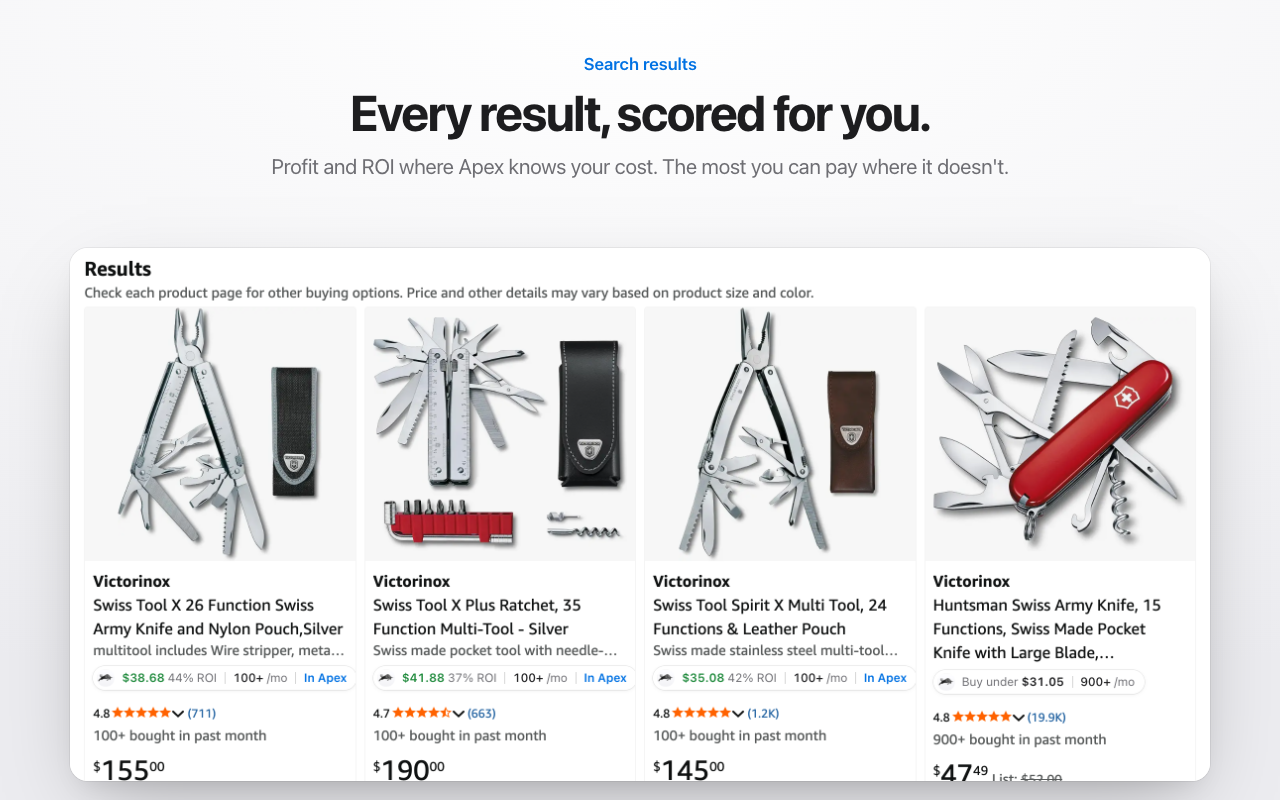
Doing this by hand works, but it's slow on a price list with thousands of lines. An Apex Green scan matches a whole list to Amazon and shows ROI, margin, the number of sellers, whether Amazon is on the listing and hazmat or meltable flags for each product, so the same comparison takes far less time:
Then score each category against this list. The one that ticks the most boxes is usually the place to start:
- Most sampled products sell steadily all year, not in one spike
- On most listings, a handful of FBA sellers or fewer sit at the competitive price
- Amazon sells few of the sampled products itself
- Profit after Amazon's fees and your landed cost clears your target ROI
- More than one supplier you could open an account with carries the brands
- Expiration dates, heat, hazmat and size rules are ones you can manage
- Your account can list the products, or you have a clear path to approval
One category or several?
Amazon's guide to finding wholesalers puts the question this way: "Would you like to focus on a single niche or carry a wide selection of different items?"
Early on, one or two related categories is usually the better answer. You build deeper supplier relationships, you learn what a good product looks like there, and you get faster at spotting a bad one. Related categories also share suppliers. Many distributors carry grocery, health and household lines side by side, and the Vault's General merchandise section is full of them.
Once your sourcing and purchase orders run smoothly in one category, adding a second spreads your risk. A rule change, a new wave of sellers or a brand that stops selling to resellers then hits part of your catalog instead of all of it. The mistake to avoid is spreading out before the process works in one place. That just repeats the same gaps across more products.
So which category should you start with?
Start with the consumable category where your first supplier is strongest. For most new sellers that's one of the four at the top of this page: grocery, health and household, beauty and personal care, or pet supplies. Then let the numbers from your sample overrule the label. A quiet, profitable listing in a less popular category beats a crowded one in a famous category.
Next, line up suppliers in that category. Our guide to wholesale suppliers covers finding and vetting them, and the distributor email templates give you the first message to send.
Apex for Amazon Sellers is free to install, and its numbers open when you finish Apex University. Create a free account, work through the lessons, then install it from the Chrome Web Store.
New sellers under $5,000 a month in Amazon sales. Unlimited supplier price lists a month, up to 50,000 lines, 500 products, purchase orders and profit and loss.
7 days free, then $49.99 a month, plus tax where applicable. Card required, nothing charged until day 8. Cancel any time before then.
Sources
- Selling plans and pricing, Amazon
- How to find wholesalers, Amazon
- Product ideas: tap into Amazon Best Sellers lists, Amazon
- How to sell groceries in the Amazon store, Amazon
- What Amazon FBA sellers should know about dangerous goods, Amazon
- Expiration-dated products, Amazon Seller Central
- FBA prep, packaging, and labeling: A beginners guide, Amazon
- Children's Product Certificate, U.S. Consumer Product Safety Commission
Some of Amazon's pages need a Seller Central sign-in to read, and we have not yet checked their current wording for this version of the page. If Amazon's page and this guide disagree, Amazon's page is the one that counts.
We build software for Amazon sellers who buy from wholesale suppliers, and we write these guides from what we see in that work.