Amazon wholesale suppliers: how to find and vet them
Amazon wholesale suppliers are the brands and authorized distributors that sell you branded products by the case. Find them by asking brands who they supply, checking brand websites, searching by category, and meeting them at trade shows. Before you pay, check that the business is real, can show where its stock comes from, and issues invoices Amazon accepts.
- Buy from the brand or one of its authorized distributors. Amazon's own wholesaler guide says branded products should come from one of those, and that auctions and liquidation are not valid sources of supply.
- The quickest route to a good distributor often runs through the brand: ask who it supplies, even when it won't sell to you itself.
- Vet before you pay: a business you can look up, proof it can sell the brand, a sample invoice with the details Amazon checks, and a small first order.
- Treat every supplier list as a list of leads, ours included. Being listed somewhere doesn't prove a company is authorized for anything.
This is stage 5 of the Amazon wholesale roadmap. By now you have a seller account and the paperwork distributors ask for, which the step-by-step start guide covers, and you know that some products need Amazon's approval. What's missing is someone who will sell to you.
Finding names is the easy half. The half that costs money is learning, after the pallet arrives, that the supplier can't give you an invoice Amazon will accept, or that the brand doesn't want its products on Amazon at all. This guide covers both halves. The rules in it come from Amazon's own US pages, listed under Sources at the end. The sourcing methods come from Stef, who teaches the Finding Suppliers lesson in Apex University, and from Apex's internal distributors playbook.
Three kinds of supplier, and the ones Amazon wants
Every wholesale supplier falls into one of three groups, and the group tells you what paperwork you'll end up with.
The brand
The company that owns the trademark, often also the manufacturer. Buying direct gives you the cleanest paper trail there is, and only the brand can give you a letter of authorization. The catch is that big brands rarely open accounts for small resellers. Most sell through distributors, with minimums sized for retail chains. A brand that won't sell to you is still worth contacting, because it can tell you who it supplies (method 1 below). When a brand will sell to you, our guide to buying brand direct covers how to approach it and what to agree.
Authorized distributors and wholesalers
Companies that buy from brands in volume and sell by the case to retailers, Amazon sellers included. This is where most new sellers open their first accounts, and since one distributor can carry a long list of brands, one approved application can open a whole catalog.
Authorization is given brand by brand, though. A distributor can be authorized for some lines on its price list and buy others wherever it can, so ask about the brands you actually want. Our explainer on how Amazon wholesale works shows where brands, redistributors, distributors and wholesalers sit in the chain.
Everyone else
Liquidators, closeout sellers, auction lots, retail stores and websites, other Amazon sellers, and "wholesalers" who can't say where their stock comes from. The products may be perfectly genuine. The problem is the paper: none of these can show that your units trace back to the brand, and Amazon says some of them are not valid sources at all. The last section lists them.
Ten ways to find wholesale suppliers
Roughly in the order we'd try them. The first four cost nothing but time. The later ones cost money, or work best once you already have a supplier or two. Whichever you use, keep going until you have more than one account. With only one supplier, a single price rise or stockout stops your restocks.
1. Ask the brand who it supplies
Start on Amazon, not on Google. Pick products you'd like to sell, note the brand, and find the company behind it; the brand's website usually names its parent company or manufacturer. Then contact its sales or wholesale team.
You're not asking to open an account. You're asking where you can buy. Stef calls this reverse sourcing, and near the end of the lesson he sums it up: find the brand on Amazon, find its manufacturer, ask for its distributors, then ask each distributor what it needs to open an account for you. If a large distributor says no too, ask it the same question: who do you sell to that I could buy from? A no often comes with names. Our guide to finding brands to wholesale walks through reverse sourcing step by step.
This route also starts the relationship you'll need if you ever want a letter of authorization. Our distributor email templates include the first email to a brand, ready to copy.
2. Look for a distributor list on the brand's website
Many brands publish their authorized distributors, often to steer buyers away from unauthorized sellers. Look for pages called "where to buy", "find a distributor", "wholesale" or "become a retailer", and check the footer. A distributor you found on the brand's own page comes with a reason to trust it, and a good opening line for your application.
3. Search a category, then sort by website
Search for distributors in the category you want to sell in, such as "grocery distributor" or "pet supplies distributor", adding your state if you'd like someone nearby. A brand name with "authorized distributor" works too. Stef also asks an AI chatbot for a list of a hundred distributors in a category. Treat any list like that as leads, not facts: chatbots can name companies that have closed, merged or never sold to resellers.
The website check is where the time is saved. Look at what each company sells and who it sells to. In the lesson, Stef crosses off one food distributor in seconds, because its site shows meat and vegetables, which he says aren't items you typically want to sell on Amazon, and keeps the ones whose sites list the household and grocery brands they carry.
"Quickly look and understanding a supplier based on their website is gonna save you a ton of time. Because applying for these companies is time-consuming, and we're not here to waste time."
From Stef's lesson (Finding Suppliers, at 7:43)
If you sell grocery, our grocery guide applies all of this to one category.
4. Find your best distributor's competitors
Once one distributor works out, look up its competitors and apply to them too. Stef's reasoning in the lesson: when one supplier is out of a product, another may have it, and when one quotes a price, another may quote a better one. Two accounts that carry the same brand also give you something real to mention when you negotiate.
5. Wholesale directories
Directories list suppliers by category, with a profile and contact details for each. They save research time, and Stef walks through one in the lesson, pointing out that the companies in it paid to be listed. A listing is advertising, not a background check, so every supplier you find this way still goes through the vetting steps below.
Amazon's wholesaler guide also points to its Service Provider Network, though when we looked, the US network had no category for wholesale suppliers. Apex's own directory, the Distributor Vault, is covered below.
6. Trade shows
Wholesale shows put hundreds of brands and distributors in one place, all looking for new retail accounts. General merchandise shows such as ASD Market Week say they serve online stores as well as physical shops, and most categories have shows of their own.
Shows cost travel and days away from work, so plan before you go. Stef's method, from the trade show part of his lesson: get the exhibitor list from the show's website, look up their brands on Amazon, and walk in knowing the five or six companies you want to meet. A show is also a second chance with a company that turned down your email. If you can't travel, search for shows in your own state or category.
7. Regional distributors near you
Regional distributors, especially in grocery, household and health products, often take smaller accounts than national ones, and a supplier near you or your prep center means cheaper freight and quicker deliveries. Search your state or metro area with the category, and have your resale certificate ready, since nearly every distributor asks for one.
8. Sales reps
Brands and distributors employ sales reps whose job is opening new accounts. A short, specific message to the right rep on LinkedIn, or a phone call, often gets further than a general inquiry form, because you're reaching someone who can say yes. Our email templates include a phone script too.
9. Other sellers
Sellers outside your category are often happy to share a supplier, since you won't be competing for the same listings. Ask what the supplier wanted at sign-up and what its invoices look like, not only its name.
10. Your prep center
Prep centers receive stock from many wholesale sellers, so they see which suppliers ship clean, well-labeled cases on time. Once you're a client in good standing, ask who they'd recommend in your category. Our guide to FBA prep centers covers choosing one.
How to vet a wholesale supplier before you buy
Amazon puts this job on you. Its stolen goods policy says it in one line: "As a seller, you must validate your supply chain." Its page on selecting reliable suppliers lists what to look at, and its anti-counterfeiting policy says selling inauthentic products can cost you your account, your payouts and the inventory itself.
None of these checks is hard. Run them in this order, because the early ones cost nothing and catch the worst suppliers first.
Step 1. Check that the business is real
Do this before you fill in an application. Amazon's due diligence page, and the supplier FAQ on its invoice page, suggest checks like these:
- Look up the company on the Secretary of State business search for its state, and note how long it has been registered.
- Confirm a physical office or warehouse, not only a mailbox.
- Check its Better Business Bureau profile, and search its name with "complaints" and "scam".
- Look at its website and wider presence: brand websites, trade show exhibitor lists, industry news.
- Ask whether it can provide a certificate of insurance covering the products.
Step 2. Ask for proof it can sell the brand
Ask directly: are you authorized by this brand, or do you buy it from someone else? Amazon's due diligence page suggests confirming whether the supplier is an authorized distributor, reseller or partner of the brand, checking whether it can show a letter of authorization from the brand or invoices from its own supplier, and contacting the brand to cross-check. Ask about the specific brands you want. Vague answers, or "we can get any brand", are an answer too.
Step 3. Ask whether the brand allows Amazon sales
Some brands restrict where their products may be sold, set a minimum advertised price (MAP), or limit how many online resellers they supply. Ask before you order, and get the answer in an email. A brand that doesn't want its products on Amazon can make that expensive for you, from asking its distributors to stop selling to you to filing complaints about your listings, which our account health guide explains.
Step 4. See a sample invoice before the first order
The supplier's invoice is what you'll show Amazon to get approved for a gated product, and again if a buyer or a brand ever questions your units. Ask for a sample, with prices hidden if they prefer, and check it against Amazon's list. Our guide to ungating invoice requirements goes through it line by line.
Amazon's page on invoices for appealing a policy violation adds the supplier's phone number and website, product identifiers such as model numbers or UPCs, and a PDF or image file. Two things are easy to fix now and hard to fix later:
- Your business name and address. Open the supplier account in exactly the name and address on your seller account, so every invoice matches.
- Product identifiers. If the supplier's invoices show only its own item codes, ask whether it can print UPCs or model numbers, or keep the price list that maps its codes to UPCs.
Step 5. Check the catalog fits Amazon
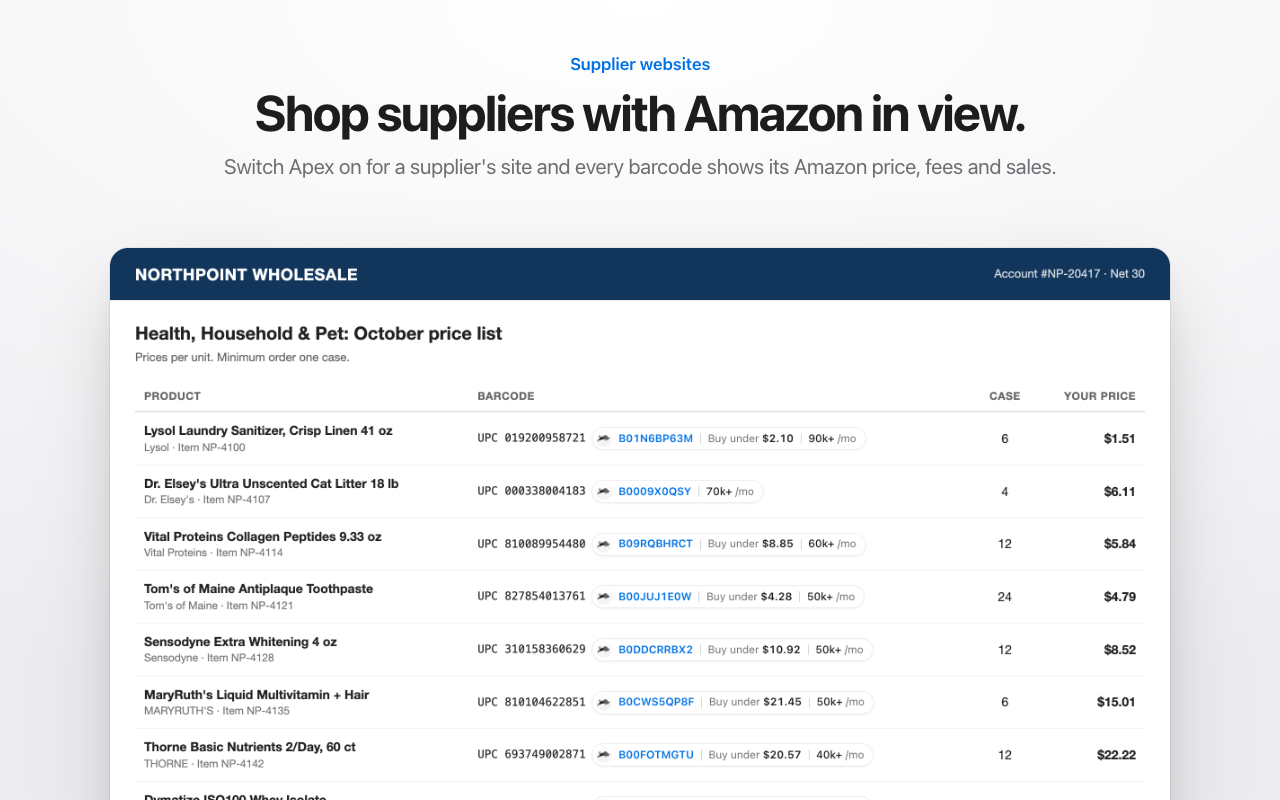
A real, authorized supplier can still be a poor fit: products Amazon sells itself at a low price, fresh or frozen goods, minimums you can't sell through. Run the price list against Amazon before you commit, on your landed cost rather than the list price, so freight, prep and Amazon's fees are in the numbers. Our guide to analyzing a wholesale price list goes line by line, and the Chrome extension can show Amazon's numbers next to the barcodes on a supplier's own website.
Step 6. Start small, and keep checking
Your first order tests the supplier as much as the products. Check what arrives against the invoice: the right items and case packs, expiry dates with plenty of time left, nothing damaged or used, and an invoice exactly as the supplier issued it. Note how many days delivery took, because that's the lead time your restocking will depend on. Our first wholesale order guide covers how much to buy.
After that, Amazon's due diligence page suggests monitoring a supplier's performance, quality and compliance regularly, and being ready to look elsewhere if it slips. A distributor that could sell a brand last year may not be able to this year.
Red flags
Most of these come from Apex's internal distributors playbook and Amazon's guidance, and the rest are our own advice. One on its own may have an innocent explanation. Two together, walk away.
- Nothing you can verify. No registration you can find, no real address, or a refusal to share basic business or tax documents.
- Fees to see a catalog or open an account. Real distributors make their money selling you products.
- Prices far below every other authorized source. That often means diverted or gray-market stock, or worse. Amazon's stolen goods policy covers products obtained illicitly "at any point in the supply chain".
- A Gmail or Yahoo address for a company that calls itself a distributor.
- Vague answers about authorization, or a promise to get any brand you name.
- No proper invoice. Only receipts, handwritten bills or editable spreadsheets.
- Pressure to wire money for a large first order before you have any history together.
- Bad reviews, unresolved complaints, or no footprint in its industry at all.
- Are you authorized by the brands I want? Can you show a letter from the brand, or your own invoices from it?
- Does each brand allow its products to be sold on Amazon? Is there a MAP policy or any other channel restriction?
- Can your invoices show my business name and address, your phone number and website, and a UPC or model number for each line?
- What is your minimum opening order, and your minimum on reorders?
- How do new accounts pay, and when do payment terms become available?
- What is your usual lead time, and which warehouse would ship to me?
- Can you send a current price list with UPCs and case packs?
- What is your process for damaged, short or wrong deliveries?
- Have you supplied online resellers before?
Opening the account
Once a supplier passes, the application is mostly paperwork. Distributors want to see a real reseller: a registered business with an EIN, a resale certificate, a website and email on your own domain, and a business address that can take deliveries. Our guide to opening a wholesale account covers each one, the application and opening order minimums, and the distributor email templates give you the first email, the follow-ups and what to say when a distributor asks whether you sell on Amazon.
Expect the first months to be about trust. Stef's experience, from the lesson:
"Some companies, they're not going to give you the best prices from the beginning. You have to spend a few dollars... buy one or two... POs before they even take you seriously, before you can ask them about certain products that they may or may not have."
From Stef's lesson (Finding Suppliers, at 21:24)
After that, the account is worth more than its price list. In the same part of the lesson, Stef describes asking a supplier about a brand's products that weren't on its list. A supplier with access to the brand may be able to order them in for you against a purchase order.
When a distributor says no
Apex's internal distributors playbook lists the usual reasons: wariness of Amazon resellers because of unauthorized sellers or MAP problems, an order minimum or volume you don't meet yet, no track record, or a brand that limits its online resellers. Ask politely why, offer a small first order, put a commitment to the brand's MAP policy in writing, and ask about other lines. Then ask the question from method 1: who do you sell to that I could buy from?
Keep a supplier list
Track every supplier you contact: who you spoke to and when, what they asked for, their minimums and lead times, and where things stand. A spreadsheet works fine. The playbook's rule of thumb is a shortlist of five to ten promising distributors before you start reaching out, so one slow reply doesn't stall you. In Apex, Apex Blue keeps this on its Vendors page: each supplier's rep and contact details, minimums, how you pay, and the lead time restocking can use.
Negotiating better terms
Negotiation comes after trust. A new account usually pays up front at list price until you've ordered and paid on time a few times. After that, the levers that work for a small reseller are volume, payment terms, a forecast of next quarter's orders, and a quote from a second distributor that carries the same brand. Our guide to negotiating with distributors has the scripts.
One habit pays from the first reorder: compare the unit costs on each new invoice with the last one. Price increases arrive quietly, and a few cents a unit can turn a profitable product into a break-even one.
The Distributor Vault
The Distributor Vault is Apex's directory of US wholesale distributors, sorted by category: grocery and food, candy and snacks, health and supplements, beauty and cosmetics, pet supplies, toys, cleaning, home goods, general merchandise and more. Think of it as a head start on methods 3 to 5: companies to research, grouped by what they sell.
What it is, and what it isn't:
- Contact details open with a subscription. Every subscription, trial included, opens 3 US wholesale distributors from the Distributor Vault when it starts and 3 more each month. Yearly billing, on Starter and Pro, opens the whole Vault at once.
- It isn't an endorsement. A company being in the Vault doesn't mean it's authorized for a particular brand or will open an account for you. The Vault doesn't confirm whether each company sells to Amazon resellers, so check its terms before you apply.
- The vetting steps above still apply to every company in it, as they do to a name from any other list.
The yearly billing that opens the whole Vault also costs 20% less than paying monthly, on Starter and Pro.
Sources Amazon will not accept for approvals
Some sellers offer genuine products at good prices and still can't give you what Amazon asks for. Approval for a gated product is decided on documents, and Amazon's wholesaler guide is specific about whose: a purchase invoice from a manufacturer or distributor, or a letter from the brand authorizing you to sell its products. Amazon's page on categories and products that require approval lists what to prepare for each category. It needs a sign-in, and we could not open it to check its current wording.
| Source | Why it fails for approvals | Read more |
|---|---|---|
| Retail stores and retail websites | A store receipt isn't an invoice from a manufacturer or distributor, so it can't support an application for a gated product | Invoice requirements |
| Liquidation pallets, closeouts and auctions | Amazon says auctions and liquidation are not valid sources of supply | Amazon's wholesaler guide, in Sources |
| A retailer or another Amazon seller shipping straight to your buyer | Amazon's drop shipping policy prohibits it when you aren't the seller of record on the shipment | Dropshipping on Amazon |
| Wholesale marketplaces built for independent shops | Faire, for one, says it can't fill orders for retailers who sell on Amazon, so buying there for Amazon breaks its rules before approval even comes up | Faire's terms, just below |
| A "wholesaler" that can't say where its stock comes from | It can't show the provenance Amazon's due diligence page asks you to check | The vetting steps |
Faire's help center for retailers says it is unable to fulfill orders if you are selling on Amazon, eBay, Etsy, TikTok or other marketplaces, and that it does not support shipping to fulfillment centers.
The documents matter as much as the source. For appeals, Amazon's invoice page says it won't accept sales quotes, pro forma invoices, self-issued invoices, or invoices that have been digitally manipulated or come in an editable format such as Excel or Word. Ask every supplier for final invoices as PDFs from the start, and keep each one with its order; our account health guide covers the records to keep.
Questions about Amazon wholesale suppliers
How do I know if a wholesale supplier is legitimate?
Look it up before you apply: a state business registration you can find, a real office or warehouse, some history in its industry, and no pile of unresolved complaints. Then ask whether it's authorized for the brands you want, and for a sample invoice. A legitimate distributor answers both readily.
How many wholesale suppliers should a new Amazon seller have?
Start with one or two while you learn, and keep applying until you have a few active accounts you could reorder from. A single supplier is a single point of failure: one price rise, a stockout or a change in its terms stalls your restocks. That's our rule of thumb, not a target. A few suppliers you reorder from are worth more than a long list of accounts you never use.
Can I buy products on Faire and sell them on Amazon?
Faire's own rules say no. Faire is a wholesale marketplace for independent shops, and its help center for retailers says it can't fill orders for retailers who sell on Amazon or other marketplaces. For a brand you'd like to sell on Amazon, buy from the brand itself or one of its authorized distributors.
Does buying from an authorized distributor guarantee Amazon approval?
No. Amazon decides each application on your account, the product, brand or category, and the documents you send. An invoice from an authorized distributor is what Amazon's own guide asks for, so it's the right place to start. For some brands, though, Amazon's application asks for a letter of authorization from the brand itself, and only the brand can give you that. The ungating guide covers the whole process.
Is it worth paying for a list of wholesale suppliers?
A list saves search time, and that's all it can do. The same lists circulate widely, a name on a list says nothing about whether the company is authorized for a brand or will open an account for you, and you still have to vet every name. The Distributor Vault is our own list, and the same goes for it. Never pay a supplier itself just to see its catalog.
Every guide in this part
- Brand-direct wholesale on Amazon: how to pitch a brandWhat brands want from an Amazon reseller, how to pitch one, what Amazon will and will not enforce for you, and exclusivity promises to be careful with.Read
- How to email a wholesale distributor or brand (copy-paste templates)Copy-paste emails for a first message to a distributor or brand, an honest answer to 'do you sell on Amazon?', follow-ups, an LOA request and a script.Read
- How to find brands to sell on Amazon wholesaleWays to find brands worth approaching for Amazon wholesale: reverse sourcing from listings, seller storefronts, distributor lists and brand searches.Read
- How to negotiate wholesale prices with distributorsWhen to negotiate, the levers that work for a small Amazon reseller, word-for-word scripts, and how to catch price changes on your reorders.Read
- The Distributor Vault: a list of US wholesale suppliers to researchBrowse US wholesale suppliers by category, no account needed, and research each one before you apply. Contacts open with a subscription.Read
Names and categories are public, and contacts open with a subscription.
Browse the Distributor VaultEvery subscription, trial included, opens 3 US wholesale distributors from the Distributor Vault when it starts and 3 more each month. The first three that open are the same for every account, so they may not be in the category you want. Yearly billing, which opens the whole Vault at once, is on Starter and Pro.
Beginner, $49.99 a month
Start my 7-day trial on Beginner7 days free, then $49.99 a month, plus tax where applicable. Card required, nothing charged until day 8. Cancel any time before then.
Sources
- How to find wholesalers, Amazon
- Select reliable suppliers with due diligence, Amazon Seller Central
- Invoice requirements for appealing a policy violation, Amazon Seller Central
- Amazon Stolen Goods Policy, Amazon Seller Central
- Amazon anti-counterfeiting policy, Amazon Seller Central
- Categories and products requiring approval, Amazon Seller Central
- Drop shipping policy, Amazon Seller Central
- Service Provider Network, Amazon Seller Central
Reported by others
- What types of businesses can buy on Faire?, Faire Help Center
Some of Amazon's pages need a Seller Central sign-in to read, and we have not yet checked their current wording for this version of the page. If Amazon's page and this guide disagree, Amazon's page is the one that counts.
How do I check a supplier price list? How many units should my first order be?