Reselling on Amazon: the business models, the rules, and where to start
Reselling on Amazon means selling products another company makes, usually on a product page other sellers share. The main ways to get stock are wholesale, online arbitrage and retail arbitrage, and each has its own Amazon rules. Wholesale is the one built for repeat orders, because the same supplier can restock the same products.
- Resellers sell existing brands on shared product pages, and Amazon decides which offer gets the Add to Cart button.
- Every model sits under the same rules: genuine products, approval where Amazon asks for it, and records that trace your stock back to a real supplier.
- Two popular shortcuts fail Amazon's own rules: retail-to-retail dropshipping, and buying stock from liquidation lots or auctions.
- Wholesale gives up brand ownership and the highest margins in exchange for proven demand and suppliers you can reorder from.
- There is nothing to buy at this stage. Learn the model first, then set up the business.
This is where the roadmap starts. It explains what reselling on Amazon actually involves, puts the common business models side by side with the rule Amazon applies to each, and says why Apex is built around wholesale and what that choice costs you. By the end you should know which model fits the money and time you have, and what to do next.
If you'd rather watch first, this is The Game, the first wholesale lesson in Apex University. Stef, who teaches the course, has sold both ways, and he compares private label with wholesale and explains why the course focuses on wholesale.
What reselling on Amazon means
Reselling means selling products another company makes. You don't design the product or own the brand. You buy finished goods, the same toothpaste or detergent shoppers already know, and sell them in Amazon's store. Amazon's own guide to reselling describes a reseller as someone who buys from wholesalers or other retail partners and sells those products in its store.
You'd be in good company. In that same guide, Amazon says more than 60% of sales in its store come from independent sellers. That number counts brand owners and resellers together, and the guide doesn't give a figure for resellers alone.
Three things make reselling on Amazon different from running your own shop.
One product, one page, many sellers
On Amazon, each product has one detail page, identified by its ASIN. When you resell something that's already in the catalog, you don't build a listing of your own. You add your offer to the existing page, next to everyone else who sells the same item.
Amazon picks the offer shoppers see first
When several sellers offer the same item, Amazon chooses which offer goes in the box with the Add to Cart and Buy Now buttons. Amazon calls it the Featured Offer, and most sellers still call it the Buy Box. The other offers sit in a list below it.
Amazon doesn't publish a formula, but it does say what helps. Featured offers are commonly priced at or below the lowest alternatives. Offers with fast shipping at no charge are more likely to be featured, and a consistently good order experience helps. An item that's out of stock can't be featured, and sometimes no offer on a page is eligible at all. Because the product is the same whoever sells it, what sets your offer apart is your price, your stock, your delivery and how well you look after buyers.
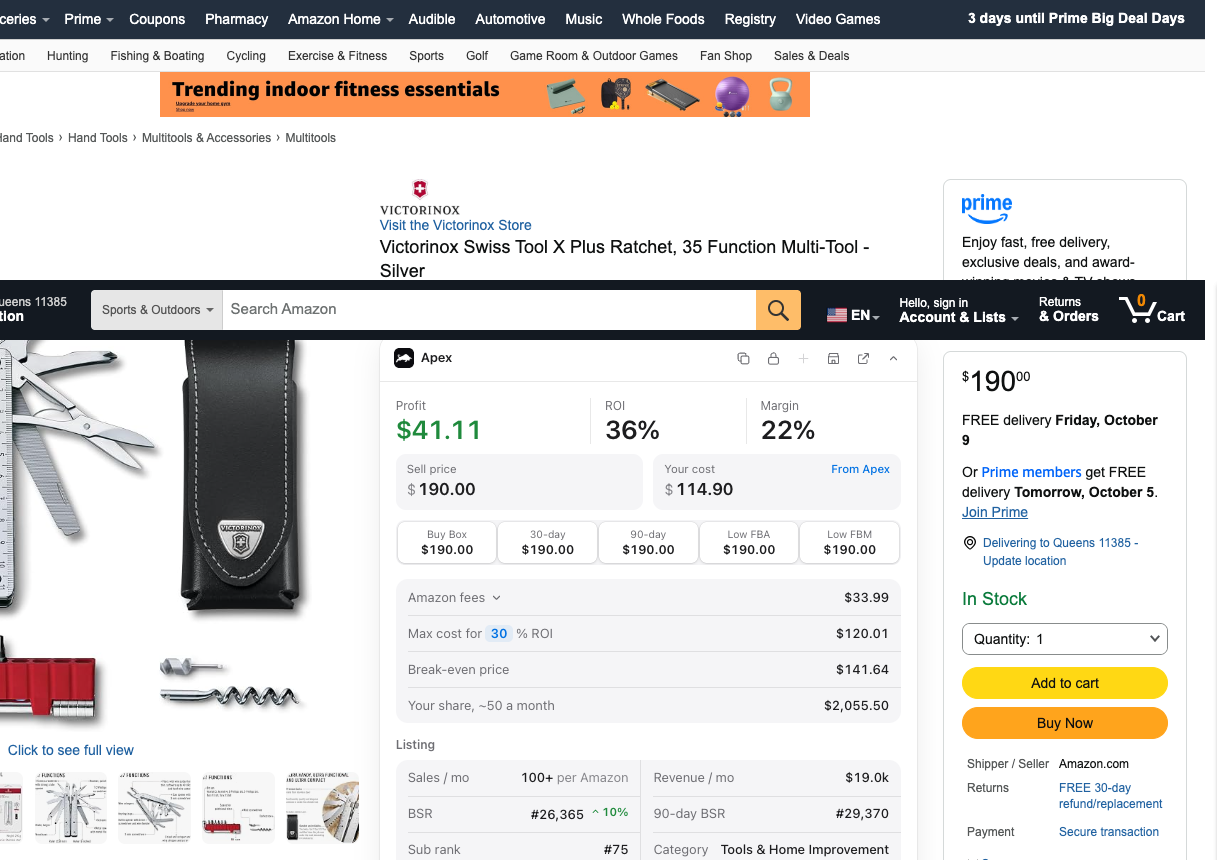
Before you buy anything to resell, look at who holds that box and how many sellers share the page. In the example above, the seller in the box is Amazon. Our rule of thumb, and it's ours rather than Amazon's, is that a listing Amazon sells itself is a hard place for a new reseller to win sales, so it's one of the first things worth checking.
Resellers and brand owners play different parts
The brand owner controls the brand. In Amazon Brand Registry, a brand can hold the protection roles, report suspected infringement, and give a Reseller role to the third-party sellers it has authorized to sell its goods (Amazon's guide to Brand Registry roles). A reseller sells the same goods without controlling the brand or the content of the page.
That split explains most of the rules further down. The product isn't yours, so Amazon wants to know that what you sell is genuine, that it's in the condition you say, and that it came from a supply chain you can document.
The models side by side
Every way of reselling on Amazon answers one question: where does your stock come from? Here are the common answers, the rule Amazon applies to each, and the mistake new sellers make most often. Private label isn't reselling, but it's in the table because it's the model everyone compares against.
We haven't put dollar figures in the money column. What you need depends on your suppliers' minimums and the products on your list, and the cost to start guide works through budgets.
| Model | How it works | Amazon's rule | Money needed | Common mistake |
|---|---|---|---|---|
| Wholesale | Open an account with a brand or its distributor, buy by the case, and sell on the existing listing | For a product that needs approval, Amazon asks for a manufacturer or distributor invoice, or the brand's authorization letter (Amazon) | Set by each supplier's opening order and case packs; varies with your list | Buying from a "wholesaler" who is really a liquidator or another reseller |
| Online arbitrage | Buy discounted products on retail websites, receive them, then resell them | A product bought from a retailer may need extra documents, such as invoices; having the retailer ship straight to your buyer is retail-to-retail dropshipping, which Amazon prohibits (Amazon) | Low to start, because you buy one deal at a time | Expecting a retailer's receipt to get you approved for a gated brand |
| Retail arbitrage | The same, in physical stores, usually with a scanning app | Amazon says it can work if you follow its selling guidelines, and the same document rule applies (Amazon) | Low to start | Treating a clearance find as supply you can reorder |
| Brand direct | Buy straight from the brand, sometimes as one of a few authorized sellers | A brand can give its authorized sellers the Reseller role in Brand Registry (Amazon) | Varies; brands often expect steady volume | Asking for exclusivity before you have a sales record with the brand |
| Bundling | Combine products into a set that gets its own listing | For consumables, the brand must have packaged the bundle, or you need its letter of authorization, and every item must be the same brand (Amazon) | Low to medium | Bundling another brand's products without its permission |
| Dropshipping | Customers order from you and a supplier ships to them | Allowed only when you are the seller of record on everything the buyer receives and you handle returns; buying from another retailer and having it ship to your buyer is not allowed (Amazon) | Little stock to buy, but you carry every order's risk | Filling orders by buying from another online store |
| Liquidation | Buy returns, overstock or pallets at a deep discount and resell them | Amazon's guide to reselling says auctions and liquidation are not valid sources of supply (Amazon) | Low per unit, with unknown condition | Listing opened or returned goods as New |
| Private label (the contrast) | Create your own brand and have a manufacturer make the product | To enroll in Brand Registry, you need a registered or pending trademark that you own (Amazon) | The highest: product, packaging, launch and advertising | Underestimating how long a new listing takes to sell |
Some of Amazon's rules live on Seller Central help pages that need a sign-in, so we couldn't check their current wording. Where Amazon says the same thing on a public page, we link that page, and the sources at the end list both.
Wholesale
Wholesale means buying from a brand, or from a distributor the brand sells through, at a wholesale price, and reselling on Amazon. The products already sell, so you can see the demand, the price history and the competition before you spend anything. How Amazon wholesale works walks through where the money comes from, step by step.
One wrinkle in the vocabulary is worth knowing. When Amazon's own seller blog talks about how to sell wholesale on Amazon, it means selling in bulk to business buyers through Amazon Business. Resellers use the word for the buying side: you buy wholesale, then sell to everyday shoppers.
Not every wholesale source welcomes Amazon sellers, either. Faire's help center for retailers says it can't fill orders for anyone who sells on Amazon, eBay, Etsy or similar marketplaces. Read a wholesale platform's terms before you buy there to resell on Amazon.
Online and retail arbitrage
Arbitrage means buying below the Amazon price from another retailer, on a website or in a store, and reselling the item on Amazon. It's the cheapest way to learn how listings, fees and prep work, because you can start with a handful of items.
The catch comes later. A good deal rarely repeats, so each sale means finding the next one. And a store receipt isn't the manufacturer or distributor invoice Amazon asks for when a product needs approval. The two kinds of arbitrage are compared in depth in online arbitrage vs retail arbitrage.
Brand direct
Brand direct is wholesale without the middleman. You buy from the brand itself, which can mean the cleanest paperwork and a better price, but it's a harder door to open. Brands want to see a business that will look after their listing and their pricing, and many sellers get there after a track record with distributors. Opening those first accounts is covered in how to open a wholesale account.
Bundling
A bundle is a new product made from existing ones, so it gets its own listing. For consumables, which Amazon describes as products more likely to be eaten, applied to the skin or used by vulnerable people, its 2024 bundling update says a bundle must be packaged by the original manufacturer or brand, or repackaged with the brand's letter of authorization, and every item must be the same brand. Only gift items in the gift basket category may mix brands (Amazon's announcement). Treat bundling as something a brand approves, not a way around approvals.
Liquidation
Liquidation pallets and auction lots are sold as a cheap way to buy branded goods. Amazon's guide to reselling is blunt about them: auctions and liquidation aren't valid sources of supply. These lots often hold customer returns and opened boxes, and Amazon's condition guidelines describe New as a product in its factory packaging, as if you'd just taken it off a store shelf.
Private label
Private label isn't reselling. You own the brand, the trademark and the listing, and you're the only seller on it. Margins can be higher, and a brand can become an asset you sell one day. The price is that you have to create the demand yourself. Stef has a private label brand of his own, and in The Game he's direct about what that takes:
"Now, you are selling a product that has no sales history, meaning you need to gain traction, which will cost money for marketing and promotions."
That's from Stef's lesson The Game, 2:58. In the same passage he calls private label the riskier of the two models for someone without Amazon experience. The full comparison is in wholesale vs private label.
Dropshipping
Is dropshipping allowed on Amazon? In one form only. A supplier can ship your orders, but you must be the seller of record: your name on the packing slip and invoice, nothing that names the supplier, and returns handled by you. What Amazon prohibits is the version often promoted online, where you buy the item from another online retailer and have that retailer ship it straight to your buyer.
Amazon restated the policy in a Seller Forums announcement, which warns that breaking it can restrict your ability to sell through Amazon's Merchant Fulfilled Network, where you ship orders yourself. Its reselling guide puts it in one line: drop-shipping retail-to-retail is prohibited.
Even the allowed version is a hard way to resell. You never see the product, so you can't check that it's genuine or new before it reaches your buyer, and a late or wrong shipment is your problem with Amazon, not your supplier's. That's why this roadmap doesn't build on it.
What Amazon asks of every reseller
Whichever model you choose, the same handful of rules apply to every unit you sell.
Sell only genuine products. This is the rule everything else protects.
Get approval where Amazon asks for it. Some categories, brands and products need Amazon's approval before you can list them. Sellers call this getting ungated. The ungating guide explains how approval works, and the list of Amazon gated categories shows where it applies.
Keep invoices that trace your stock to a real supplier. When a product needs approval, Amazon's public wholesale guide lists what a supplier invoice should show.
The same paperwork is what you'll reach for if a brand ever questions where your units came from, so keep it for every product, not just the gated ones. What makes an invoice pass is covered in Amazon ungating invoice requirements.
List in the condition the item is really in. Amazon's condition guidelines describe New as factory packaging, as if bought off the shelf. Anything that has been opened belongs in a used condition, if the category allows one at all.
Label and prep every unit yourself if Amazon stores your stock. Amazon ended commingling for inventory shipped on or after March 31, 2026. Sellers who aren't a brand's Brand Representative in Brand Registry must now put an Amazon barcode sticker on their units, even when the product already has a manufacturer barcode (Amazon's announcement). Amazon's notice calls those sellers resellers, so if you resell, it applies to you. Amazon also stopped offering prep and item labeling for US FBA shipments on January 1, 2026 (Amazon's developer notice), so that work is yours or a prep center's.
FNSKU labels explained shows how to label, Amazon's barcode requirements are the rule itself, and Amazon rule changes for resellers keeps the list of what else changed.
Know what Amazon keeps before you buy. Every model pays the same selling fees, and on thin reseller margins the fees decide whether a product is worth buying. The Amazon FBA fees guide walks through each one.
Why we build around wholesale, and its real trade-offs
Every model in the table can make money. The difference is whether this month's work makes next month easier, or whether you start from zero again. That's where wholesale separates itself, and it's why Apex University teaches it and why the Apex software is built around it. Here's the case, and then the costs, because both are real.
The work compounds. In arbitrage, most buys need a fresh sourcing decision, because there's no promise the same deal exists next week. In wholesale, a supplier that sold you a product once can sell it to you again, so the work you did once, opening the account and checking the product, pays off on every reorder. To sell more of a proven product, you place a bigger order with the same supplier. An arbitrage seller who wants to double sales usually has to spend far more hours hunting for deals.
Demand is visible before you buy. You're buying products that already sell, so the listing's sales rank, its price history and the other sellers on it are there to check before any money moves. Private label has to guess at demand with every new product; wholesale buys more of what's already proven.
The paperwork holds up. An invoice from a brand or its distributor is exactly what Amazon asks for in approvals, and it's what you'll show if a listing's brand owner questions your units.
A mistake is easier to recover from. A wholesale product that sells slower than you hoped is still a brand shoppers know, and you can often move it by adjusting your price. A private label launch that misses leaves you holding stock no one else wants.
Supplier relationships become an asset. Opening accounts is slow at first, and you'll be turned down more than once. Stef's point in The Game is that this changes once you're a steady customer:
"At some point, when you're spending money with these companies, your sales reps will become an asset to your business."
That's from Stef's lesson The Game, 5:21. He goes on to describe reps who call with promotions and discounts, and who let you know when the next shipment of a product you buy every month is coming. How to negotiate with distributors covers what to ask for once you're that steady customer.
What wholesale costs you
He's just as plain about the downside. You don't own the brand, so the store you build is not an asset you can sell for much later on, and margins are lower than a successful private label. On top of that:
- You share every listing. Other sellers, and sometimes Amazon itself, compete for the same Featured Offer.
- Approvals and brands set limits. Some categories need approval, and some brands keep new resellers out entirely.
- Opening accounts takes persistence. Expect rejections before the first yes, and minimum orders once you get it.
- Cash sits in inventory. You pay the supplier before Amazon pays you, and the money stays tied up until the units sell.
- There's more to run. Purchase orders, prep, shipments, records and reorders all need a system once you have more than a few suppliers.
The challenges of Amazon wholesale takes each of these in turn, with what helps.
What growth tends to look like
Wholesale growth is rarely dramatic. The path tends to look like this:
- One supplier relationship gives you a handful of products you can reorder.
- Reorders become predictable enough to plan cash and stock weeks ahead.
- A second and third supplier cut your dependence on any one of them and widen the catalog.
- Purchase orders, costs and margins move from memory and spreadsheets into a system, which frees time for finding new products.
- The business runs on reorders and steady sourcing, instead of on whatever you found this week.
None of that needs software at this stage. It needs an understanding of the model, which is what this part of the roadmap is for.
Which model fits your money and time
Start from what you have, not from the model with the best headline margin.
| If this sounds like you | Start with | Why |
|---|---|---|
| A small budget, evenings to spare, and you want to learn how Amazon works | Online or retail arbitrage, in categories that don't need approval | Small buys teach you listings, fees and prep without a large order. Plan the move to wholesale once the numbers make sense to you. |
| Enough to cover a supplier's opening order, and you want sales that repeat | Wholesale | One approved supplier can restock the same products again and again, and its invoices support your approvals. |
| More capital, marketing skills and patience for a slow start | Private label | You own the brand, and you carry the demand risk and the launch costs that come with it. |
| You want to sell without holding stock | Not retail dropshipping | Amazon prohibits it, and the allowed version still makes you answer for a supplier you never see. |
| You already sell and want to grow | Add wholesale suppliers one at a time | Keep what works, and add products you can reorder. |
Retail arbitrage vs wholesale
This is the comparison most new resellers are really making, so here it is directly.
- Where the stock comes from. Retail arbitrage buys from a store's shelf. Wholesale buys from the brand's supply chain.
- Paperwork. A store receipt proves you bought something. A distributor's invoice is the document Amazon asks for when a product needs approval.
- Repeatability. A clearance deal ends when the shelf is empty. A distributor's catalog restocks.
- Time. Retail arbitrage spends hours on every unit you find. Wholesale spends hours on every supplier you open, and then reorders are quick.
- Money. Retail arbitrage starts with whatever you choose to buy. Wholesale starts with a supplier's opening order.
Plenty of sellers start in retail arbitrage and move to wholesale. The skills carry over, like reading a listing, checking fees and prepping units. The sourcing doesn't.
Is it legal?
Reselling genuine products is an ordinary retail business, and Amazon publishes its own guide to reselling in its store. Trouble usually comes from what is sold and where it came from: counterfeits, used goods listed as new, or stock from sources Amazon doesn't accept.
Is it worth it?
It can be, for someone who treats it as a business with thin margins per unit and real work at every stage, not as passive income. Whether it's worth it for you depends on your money, your time and how the fees land on products you can actually buy, and is Amazon FBA worth it works through that question.
Where to start
You don't need to buy inventory yet. These steps come first, and they put the expensive decisions in the right order.
- Finish The Game, then watch The Checklist
The video near the top of this page is The Game, from Apex University. The Checklist, the lesson right after it, covers the setup to finish before you contact a single supplier. The course comes with a free Apex account. Nine lessons, no card. Finishing it opens one more thing: the Chrome extension. It's free to install, and its numbers open when you finish Apex University.
- Set up the business before you contact suppliers
Distributors look at who is applying before they open an account. How to start Amazon wholesale covers the order to do things in, and the resale certificate guide covers the certificate many suppliers ask to see before they'll sell to you.
- Learn what Amazon keeps from each sale
Read the Amazon FBA fees guide, then run a few products you might sell through the profit calculator. If the numbers don't work after fees, nothing else matters.
- Check which products you're allowed to sell
Look up the categories you're interested in on the gated categories list before you fall in love with a product. Some need approval, and some brands need more than that.
- Follow the roadmap from there
The Amazon wholesale roadmap lays out every stage after this one, from finding suppliers to your first order and beyond, each with a step that costs nothing.
Questions about reselling on Amazon
What is the difference between a reseller and a brand owner on Amazon?
A brand owner owns the trademark and, through Amazon Brand Registry, can report suspected infringement and give the sellers it authorizes a Reseller role. A reseller sells that brand's genuine products on the same product page as other sellers, without owning or controlling the brand. That difference is why the source of your stock matters so much: buying from the brand or its distributors is how a reseller shows its products are genuine.
Can I run more than one model?
Yes, and many sellers do, often starting with arbitrage and adding wholesale suppliers over time. Amazon's rules apply to every unit whatever its source, so keep the records for each one: receipts for arbitrage buys, invoices for wholesale orders. Expect retail receipts to carry less weight than distributor invoices if a product needs approval or a brand questions your units. The one model to leave out is dropshipping from other retailers, which Amazon prohibits.
Every guide in this part
- Amazon wholesale vs private label: which one fits youWholesale and private label compared on money, time, risk, approvals and control, in one table, so you can pick the model that fits your situation.Read
- Is Amazon FBA worth it? An honest answer for each business modelWho Amazon FBA still works for, who should not start, what it costs to begin, how long money takes to come back, and how to test it cheaply first.Read
- Online arbitrage vs retail arbitrage: what each is, and which fits youWhat online arbitrage and retail arbitrage mean, how each works on Amazon, the rules that apply, the time and money each takes, and when to move on.Read
- The real challenges of Amazon wholesale, and how sellers get past themThe problems that stop new wholesale sellers, from approvals and supplier replies to thin margins and cash flow, with the page that solves each one.Read
- What is Amazon FBA wholesale, and how does it work?How Amazon FBA wholesale works: who you buy from, how goods reach Amazon's warehouses, where the money goes on each sale, and what it takes to start.Read
Apex University comes with a free Apex account: nine lessons, no card.
Start Apex UniversityYou don't need to pay for anything at this stage.
Apex for Amazon Sellers is free to install, and its numbers open when you finish Apex University. Create a free account, work through the lessons, then install it from the Chrome Web Store.
Sources
- Guide to reselling in Amazon stores, Amazon
- The Featured Offer (formerly the Buy Box), Amazon
- ASIN creation policy, Amazon Seller Central
- Guide to Brand Registry roles, Amazon
- Amazon Brand Registry, Amazon
- How to find wholesalers, Amazon
- How to sell wholesale on Amazon, Amazon
- Drop shipping policy, Amazon Seller Central
- Drop shipping policy reminder, Amazon Seller Forums (News_Amazon)
- Product bundling policy update for consumables, Amazon Seller Forums (News_Amazon)
- Amazon condition guidelines, Amazon
- Amazon anti-counterfeiting policy, Amazon Seller Central
- Categories and products requiring approval, Amazon Seller Central
- FBA product barcode requirements, Amazon Seller Central
- Commingling practices will end effective March 31, 2026 (US notice), Amazon Seller Forums (News_Amazon)
- SP-API changelog: US FBA prep and labeling services end, Amazon Selling Partner API
Reported by others
Some of Amazon's pages need a Seller Central sign-in to read, and we have not yet checked their current wording for this version of the page. If Amazon's page and this guide disagree, Amazon's page is the one that counts.
How do I start? Do I need an LLC, an EIN and a resale certificate? How much money?