Amazon referral fees by category, with a fee lookup
The referral fee is Amazon's cut of every sale: a percentage of the total price, shipping and gift wrap included, or a per-item minimum, whichever is greater. The rate depends on the product's fee category. Most categories charge one flat rate; a few change it with the price, and media adds a closing fee.
- The fee is a percentage of the total price (item, shipping and gift wrap), or the category's minimum when that is higher.
- Amazon decides the fee category, and it can differ from the category shoppers see. Check it before you price a product.
- In Grocery, Beauty, Baby and Clothing, the price picks one rate for the whole sale. In Electronics Accessories, Furniture, Jewelry and a few others, each rate covers only its slice of the price.
- Books, music, video, DVDs and software pay a closing fee on every item, on top of the referral fee.
- Work out the fee at the price you expect to sell at over the next few months, not just today's Buy Box price.
How the referral fee works
Every time an item sells on Amazon, you pay a referral fee. It doesn't matter whether you ship the order yourself or Amazon ships it for you through FBA. Think of it as Amazon's charge for the sale itself.
It comes on top of everything else Amazon charges: your selling plan, and the FBA fees if you use FBA. The fees guide walks through that whole stack. This page is only about the referral fee, the one fee that depends on your product's category.
Three things follow from that rule, and each one trips sellers up sooner or later.
- The fee follows the price. When your price drops, the fee in dollars drops with it. In a handful of categories the rate itself changes with the price too, which we cover below.
- Shipping counts. If you ship orders yourself and charge the buyer for shipping, the referral fee is charged on that shipping as well, not just on the item.
- Cheap items can hit the minimum. Most categories list a per-item minimum. On a low-priced item the percentage can work out to less than that minimum, and then you pay the minimum instead.
Your fee category is Amazon's call
The rate depends on the fee category, and Amazon decides which one your product is in. That is not always the category you see on the listing.
Two notes on Amazon's pricing page show how it sorts products. Bundles that contain both a camera and accessories go in Electronics Accessories. Everything Else is for products that do not clearly fit any of the other categories.
So before you price a product, check its category the way Amazon sees it. For a product that is already on Amazon, the public Revenue Calculator estimates its fees. For your own listings, Seller Central has the Fee and Economics Preview report. Amazon's 2026 fee update mentions both tools as the places that carry its new rates.
What happens to the fee when you refund an order
Look up your fee
Pick the fee category, type the total price, and the lookup does the rest. It applies the right rate for that price, checks the minimum, and adds the closing fee when you pick Media. It runs in your browser from the same table printed further down this page, so the two always agree.
Referral fee calculator
Item price plus any shipping and gift wrap the buyer pays.
Runs in your browser from Amazon's published US fee tables. Nothing you type is sent anywhere.
A few tips for getting a number you can trust:
- Type the price you expect to sell at, not the highest price the listing has had lately. More on why in the section on the most you can pay.
- Add shipping if you charge it. If you ship orders yourself and the buyer pays for shipping, add it to the price.
- Watch the "Share of the price" line. That is the percentage Amazon really takes at this price, after tiers, the minimum and any closing fee. It is the number to carry into other calculators.
- Not sure of the category? Start with the category on the listing, then confirm it with Amazon's Revenue Calculator.
Referral fees by category
Here is Amazon's full referral fee table for the US store. The rows use Amazon's own names for its fee categories, and the figures come from Amazon's public pricing page.
| Category | Referral fee | Minimum |
|---|---|---|
| Amazon Device Accessories | 45% | $0.30 |
| Appliances, Compact | 15% of the first $300.00; 8% of the part above $300.00 | $0.30 |
| Appliances, Full-size | 8% | $0.30 |
| Automotive and Powersports | 12% | $0.30 |
| Base Equipment Power Tools | 12% | $0.30 |
| Baby Products | 8% at $10.00 or less; 15% above $10.00 | $0.30 |
| Backpacks, Handbags, and Luggage | 15% | $0.30 |
| Beauty, Health, and Personal Care | 8% at $10.00 or less; 15% above $10.00 | $0.30 |
| Business, Industrial, and Scientific Supplies | 12% | $0.30 |
| Clothing and Accessories | 5% at $15.00 or less; 10% over $15.00 up to $20.00; 17% above $20.00 | $0.30 |
| Computers | 8% | $0.30 |
| Consumer Electronics | 8% | $0.30 |
| Electronics Accessories | 15% of the first $100.00; 8% of the part above $100.00 | $0.30 |
| Eyewear | 15% | $0.30 |
| Fine Art | 20% of the first $100.00; 15% of the part from $100.00 to $1,000.00; 10% of the part from $1,000.00 to $5,000.00; 5% of the part above $5,000.00Amazon applies the minimum to the first band. | $1.00 |
| Footwear | 15% | $0.30 |
| Furniture | 15% of the first $200.00; 10% of the part above $200.00 | $0.30 |
| Gift Cards | 20% | None listed |
| Grocery and Gourmet | 8% at $15.00 or less; 15% above $15.00 | None listed |
| Home and Kitchen | 15% | $0.30 |
| Jewelry | 20% of the first $250.00; 5% of the part above $250.00 | $0.30 |
| Lawn and Garden | 15% | $0.30 |
| Lawn Mowers and Snow Throwers | 15% at $500.00 or less; 8% above $500.00 | $0.30 |
| Mattresses | 15% | $0.30 |
| Media: Books, DVD, Music, Software, Video | 15%Plus a $1.80 closing fee per item. | None listed |
| Musical Instruments and AV Production | 15% | $0.30 |
| Office Products | 15% | $0.30 |
| Pet Supplies | 15%22% for veterinary diets. | $0.30 |
| Pet Supplies: veterinary diets | 22% | $0.30 |
| Sports and Outdoors | 15% | $0.30 |
| Tires | 10% | $0.30 |
| Tools and Home Improvement | 15% | $0.30 |
| Toys and Games | 15% | $0.30 |
| Video Games and Gaming Accessories | 15% | None listed |
| Video Game Consoles | 8% | None listed |
| Watches | 16% of the first $1,500.00; 3% of the part above $1,500.00 | $0.30 |
| Everything Else | 15% | $0.30 |
- A product's fee category may not be the same as the category shoppers see in the Amazon store.
- Media items also pay a closing fee on each item sold.
- Amazon lists a referral fee for Merchant Fulfilled Services, which are offered through Amazon Local Selling; it is left out here.
Source: Selling plans and pricing, Amazon
How to read the table
- "None listed" means Amazon's pricing page shows no per-item minimum for that category. That is the case for Grocery and Gourmet, Gift Cards, Media and the two video game rows.
- Fine Art is the odd one out. Amazon writes its minimum into the first price band instead of the minimum column. It still works as a floor: the fee never drops below it.
- The highest rate in the table is on Amazon Device Accessories. The lowest flat rates are on Computers, Consumer Electronics, Full-size Appliances and Video Game Consoles.
- Consumer Electronics carries a note on Amazon's page that certain cell phones may need approval. If you sell phones, check the gated categories list first.
- Merchant Fulfilled Services is left out on purpose. Amazon's page says it is for services offered through Amazon Local Selling, not for products you buy and resell.
The categories most wholesale sellers work in
If you buy from distributors, these are the categories you are likely to meet most. Here is how the rate works in each one, so you know which ones need a closer look at the price.
| Fee category | How the rate works | Per-item minimum |
|---|---|---|
| Grocery and Gourmet | Two rates; the price decides which one applies to the whole sale | None listed |
| Beauty, Health, and Personal Care | Two rates; the price decides which one applies to the whole sale | Yes |
| Baby Products | Two rates; the price decides which one applies to the whole sale | Yes |
| Clothing and Accessories | Three rates; the price decides which one applies to the whole sale | Yes |
| Toys and Games | One flat rate at any price | Yes |
| Home and Kitchen | One flat rate at any price | Yes |
| Pet Supplies | One flat rate, with a higher rate for veterinary diets | Yes |
| Sports and Outdoors | One flat rate at any price | Yes |
| Office Products | One flat rate at any price | Yes |
| Tools and Home Improvement | One flat rate at any price | Yes |
| Electronics Accessories | Two rates, each on its own slice of the price | Yes |
Where these numbers come from
The table matches Amazon's public pricing page at sell.amazon.com. Amazon also keeps a fee schedule in Seller Central, but that page needs a sign-in, so we could not compare its wording. If anything here ever differs from what Seller Central shows for your own listing, go with Seller Central.
Amazon announces its US fee changes ahead of time. Its 2026 update describes changes to FBA fees that took effect on January 15, 2026, and points to a Seller Central page for the details, which we could not open without signing in. When the referral table changes, we update it here and in the lookup at the same time, and our editorial policy explains how we check fee pages against Amazon's own.
Categories with price tiers
A handful of rows in the table have more than one rate. They work in two different ways, and Amazon's wording tells you which is which. Mixing the two up is an easy way to misjudge a referral fee.
When the price picks one rate for the whole sale
Five rows work this way: Grocery and Gourmet; Beauty, Health, and Personal Care; Baby Products; Clothing and Accessories; and Lawn Mowers and Snow Throwers. Amazon words these rows as a rate "for products with a total sales price of" a certain amount. One rate applies to the entire price, and which rate you get depends on which side of the threshold your price lands.
| Category | Referral fee | Minimum |
|---|---|---|
| Grocery and Gourmet | 8% at $15.00 or less; 15% above $15.00 | None listed |
- A product's fee category may not be the same as the category shoppers see in the Amazon store.
Source: Selling plans and pricing, Amazon
Here is the trap. Because the higher rate applies to the whole price, a grocery item priced a little above the threshold can leave you with less money than the same item priced right at it. Try it in the lookup: pick Grocery and Gourmet, type the threshold price from the row above, then type a dollar more. Amazon's fee goes up by more than the dollar you added, so you keep less.
That matters for wholesale, because the same product is often sold on Amazon both as a single and as a multipack, and you choose which listing to sell on. A single unit priced at or under the threshold pays the lower rate on everything. A two-pack or a bundle that pushes the price over it pays the higher rate on everything. Run both prices before you decide which one to sell.
Selling grocery for the first time? The grocery guide covers approval, expiry dates and the other rules that trip resellers up.
Clothing works the same way, with three bands instead of two.
| Category | Referral fee | Minimum |
|---|---|---|
| Clothing and Accessories | 5% at $15.00 or less; 10% over $15.00 up to $20.00; 17% above $20.00 | $0.30 |
- A product's fee category may not be the same as the category shoppers see in the Amazon store.
Source: Selling plans and pricing, Amazon
When each rate covers only its slice of the price
Electronics Accessories, Furniture, Jewelry, Watches, Compact Appliances and Fine Art work differently. Amazon words these rows as a rate "for the portion of" the price up to an amount, and another rate "for any portion" above it. It works like tax brackets: the first rate covers the price up to the threshold, and the next rate covers only the part above it.
| Category | Referral fee | Minimum |
|---|---|---|
| Electronics Accessories | 15% of the first $100.00; 8% of the part above $100.00 | $0.30 |
- A product's fee category may not be the same as the category shoppers see in the Amazon store.
Source: Selling plans and pricing, Amazon
Take one example. A camera and accessory bundle that sells for $150 falls in Electronics Accessories, because that is where Amazon puts those bundles. The first rate covers the price up to the threshold, and the second, lower rate covers the rest. So the share Amazon takes lands somewhere between the two rates. At $150.00 in Electronics Accessories, Amazon's referral fee is $19.00, which is 12.67% of the price. The "Share of the price" line in the lookup shows the same for any price you type.
The good news with these rows: there is no cliff. Raising your price never lowers what Amazon pays out, because the higher price only adds to the slice charged at the next rate.
Rows with their own rules
- Pet Supplies: veterinary diets pay a higher rate than the rest of the category. The lookup lists them as their own row.
- Fine Art: four price bands, each on its own slice of the price, with the minimum written into the first band.
- Everything Else: for products that don't clearly fit another category. Amazon decides when a product belongs here, not you.
Runs in your browser, no sign-in, as often as you like.
The closing fee on media
Books, DVDs, music, software and video pay a closing fee on every item sold, on top of the referral fee.
| Items | Closing fee |
|---|---|
| Media: books, DVDs, music, software, video | $1.80 per item sold |
Source: Selling plans and pricing, Amazon
On Amazon's public pricing page, the closing fee is attached only to the Media row. Video games and video game consoles have rows of their own, with no closing fee listed. The lookup adds the closing fee automatically when you pick Media.
Because it is a flat amount per item, the closing fee weighs most on cheap items. Media also lists no per-item minimum, so on a low-priced book the closing fee can be larger than the referral fee itself. You may never sell media as a wholesale seller, but if a distributor offers you books or DVDs, count the closing fee on every unit before you order.
Worked examples on two real products
These two products come from a scan of PrimeWell Distribution's catalog in Apex Green. The prices are what each product was selling for on Amazon when the catalog was scanned, and they will have moved since. We leave out what the products cost, because the referral fee doesn't depend on it.
Example 1: saltwater taffy in Grocery and Gourmet
A 5-pound bag of Taffy Town's Sassy Sour saltwater taffy was selling for $39.49. It is listed under Grocery and Gourmet Food, so its fee category is almost certainly Grocery and Gourmet. Amazon decides that, so we would still confirm it in the Revenue Calculator before buying.
Here is the working, using the Grocery and Gourmet row shown under categories with price tiers:
- Total price: $39.49, the selling price. If a buyer also paid for shipping or gift wrap, that would count too.
- Which rate: $39.49 is well above the Grocery threshold, so the higher Grocery rate applies to the whole $39.49, not just the part above the threshold.
- Minimum: Grocery lists none, and at this price it wouldn't matter anyway.
- Closing fee: none, because taffy isn't media.
- The fee: At $39.49 in Grocery and Gourmet, Amazon's referral fee is $5.92, which is 15% of the price.
What would change it: if the same taffy were sold in a smaller bag priced at or under the threshold, the lower Grocery rate would apply to the whole price. In Grocery, pack size and price decide the rate together.
Example 2: a reptile basking lamp in Pet Supplies
The Zoo Med Reptile Basking Spot Lamp, 75 watts, sold as three packs of two bulbs, was selling for $56.94.
| Category | Referral fee | Minimum |
|---|---|---|
| Pet Supplies | 15%22% for veterinary diets. | $0.30 |
- A product's fee category may not be the same as the category shoppers see in the Amazon store.
Source: Selling plans and pricing, Amazon
- Total price: $56.94.
- Which rate: Pet Supplies has one flat rate at any price. The separate, higher rate is only for veterinary diets, and a heat lamp isn't one, so the standard rate applies to all $56.94.
- Minimum: at this price the percentage is far above the minimum, so the minimum doesn't come into it.
- Closing fee: none.
- The fee: At $56.94 in Pet Supplies, Amazon's referral fee is $8.54, which is 15% of the price.
What would change it: only the price. In a flat-rate category the rate never jumps, so the fee simply rises and falls with the price.
Put the two side by side and the lesson is the same. Once you know the fee category and the price you will really sell at, the referral fee is easy. Those are the two inputs to get right: the category Amazon uses, and a price that will last.
Referral fee vs FBA fee
These two are easy to mix up, so here they are side by side.
| Referral fee | FBA fulfillment fee | |
|---|---|---|
| Who pays it | Every seller, on every item sold | Only sellers who use FBA, on every unit Amazon ships |
| What sets it | The fee category and the total price | The product's size tier, shipping weight and price |
| How it's charged | A percentage of the price, or the category minimum | A set amount per unit |
| Does it depend on your supplier cost? | No | No |
On a typical FBA sale you pay both. The fulfillment fee has its own guide, FBA size tiers and fulfillment fees, and the fees guide covers everything else Amazon can charge, from storage fees to the inbound placement fee.
If you want both fees for one product in one go, paste its ASIN into the FBA calculator, which estimates the referral and fulfillment fees together. It doesn't add the media closing fee, so for books, music, video, DVDs or software, add that yourself from the lookup above. The limit: 3 free lookups, then sign in with a plan.
What it means for the most you can pay
Fees only matter because of what they leave you. The question that decides a buy is simple: what is the most you can pay the supplier and still make the return you want?
Here is the math, one step at a time:
- Start with the price you expect to sell at.
- Take away the referral fee, the closing fee if it is media, and the FBA fulfillment fee. What's left is what Amazon pays out per unit.
- Divide that by one plus the return you want. For a 30% return, divide by 1.3.
- Take away your prep and shipping cost to Amazon per unit. What's left is the most you can pay the supplier.
The referral fee moves every time the price does. So a buy cost worked out at today's price is only as good as today's price. In a category where the price picks the rate, a price that drifts up across the threshold can even lower your payout.
This is why it pays to look past the current Buy Box price. In the Purchasing lesson of Apex University, Stef walks through a product selling at $18.41 that day, while its ninety-day average was around $10:
"So if you were to purchase this item just reading off the current buy box price, you could actually potentially be at a loss."
From Stef's lesson (Purchasing, at 10:32)
The Amazon profit calculator has a "Most I can pay" mode that works this out for you. It asks for the referral fee as a percentage, so use the "Share of the price" from the lookup above. That number already includes the tier, the minimum and any closing fee.
One difference to know about: when the profit calculator measures your return, it counts the FBA fee as part of what you put in, along with the supplier cost and your other costs. So its answer comes out lower than the four steps above. Neither way is wrong. Pick one way of measuring return and use it on every product, so your numbers compare. The wholesale profit margins guide covers what return is worth aiming for.
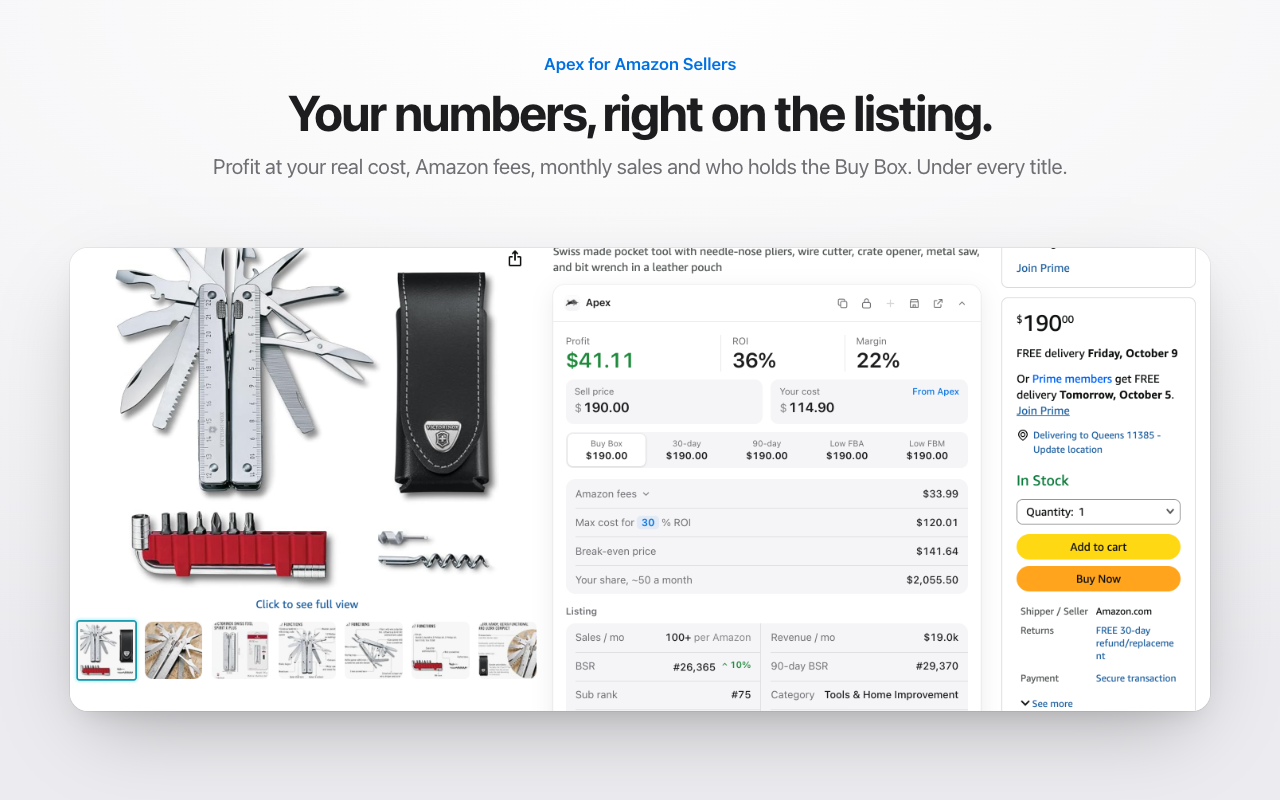
If you check products one at a time on Amazon, the Apex for Amazon Sellers extension puts the fees and the most you can pay right on the listing. Free to install, and its data opens once you finish Apex University. If you are checking a whole supplier price list, Apex Green matches each line to Amazon and works out the fees and profit for every match, so you only look closely at the ones that clear your number.
Questions about Amazon referral fees
Is the Amazon referral fee charged on shipping?
Yes. Amazon charges the referral fee on the total price, and the total price includes any shipping the buyer pays and any gift wrap. If you ship orders yourself and charge for shipping, add it to the price when you work out the fee.
Do I pay a referral fee if I ship orders myself?
Yes. The referral fee applies to every item sold, however it is shipped. What you skip by shipping yourself is the FBA fulfillment fee, not the referral fee.
Which Amazon categories have no minimum referral fee?
On Amazon's public pricing page, Grocery and Gourmet, Gift Cards, Media, Video Games and Gaming Accessories, and Video Game Consoles list no per-item minimum. Fine Art has one, but Amazon writes it into the first price band instead of the minimum column. Every other category lists one.
How do I find out which fee category Amazon puts my product in?
For a product already on Amazon, search it in Amazon's public Revenue Calculator, which estimates its fees. For your own listings, check the Fee and Economics Preview report in Seller Central. Don't rely on the category shown on the listing, because Amazon says the two can differ.
Do I get the referral fee back when a buyer is refunded?
Sellerboard reports that Amazon returns the referral fee minus a refund administration fee that you don't get back. We could not confirm the amount on Amazon's own fee schedule, which needs a Seller Central sign-in.
Profit, ROI and break-even calculator: unlimited, no sign-in.
New sellers under $5,000 a month in Amazon sales. 2 supplier price lists a month, up to 20,000 lines, 500 products, purchase orders and profit and loss.
7 days free, then $49.99 a month, plus tax where applicable. Card required, nothing charged until day 8. Cancel any time before then.
Sources
- Selling plans and pricing, Amazon
- Selling on Amazon fee schedule, Amazon Seller Central
- Update to US referral and FBA fees for 2026, Amazon
Reported by others
Some of Amazon's pages need a Seller Central sign-in to read, and we have not yet checked their current wording for this version of the page. If Amazon's page and this guide disagree, Amazon's page is the one that counts.
We build software for Amazon sellers who buy from wholesale suppliers, and we write these guides from what we see in that work.