Amazon account health and suspension: what resellers should watch, and how to stay safe
Amazon grades your account on the Account Health page, mainly through the Account Health Rating: a score from 0 to 1,000 where 200 and up is Healthy. For resellers, the violations that hurt most are authenticity and IP complaints, and many are answered with a real supplier invoice. Keep every invoice tied to its order and ASIN.
- The Account Health Rating runs from 0 to 1,000. Every new account starts at 200, the bottom of the Healthy band, and each violation costs points until you resolve it.
- Amazon's order defect rate target is under 1%. Its help page has said the rate applies only to seller-fulfilled orders, which would make policy violations the bigger risk for an all-FBA reseller. Check the page in your account: it needs a sign-in and we have not rechecked it.
- Customer reports of counterfeit products and valid infringement notices are high severity. A counterfeit finding from Amazon's own test buy is critical and takes the score to zero.
- Invoices for an appeal have strict rules: dated within 365 days of the notice, enough units to cover your sales and stock, and never an edited or editable file.
- File each supplier invoice with its purchase order the day it arrives, and look at the Account Health page every week.
This part of the roadmap is for sellers who are already selling, or about to send a first shipment in. It's the part nobody enjoys reading, and the part that protects everything else you've built. By the end you'll know what Amazon measures, why accounts get suspended, which complaints matter most for a reseller of genuine goods, and what paperwork to keep so you can answer any of them quickly.
Everything below about Amazon's rules comes from Amazon's own US help pages. Most of them need a Seller Central sign-in, and someone signed in has not yet rechecked their current wording for this version of the page. Amazon changes these pages, so the links in the Sources list are the final word. Our editorial policy explains how we check and update them.
The numbers Amazon watches
Amazon shows you how it sees your account on one page in Seller Central called Account Health. Its help pages describe three things there that matter to a reseller: the Account Health Rating, your customer service and shipping metrics, and the policy violations raised against your listings.
The Account Health Rating
Amazon describes the Account Health Rating (AHR) as a color-coded score from 0 to 1,000 that shows, in near real time, whether your account is at risk of deactivation for breaking the policies it covers. You lose points when Amazon detects a new violation, and you gain them back when you successfully address it.
| Score | Color and label | What Amazon says it means |
|---|---|---|
| 200 to 1,000 | Green, "Healthy" | Not at risk of deactivation under the policies in the score |
| 100 to 199 | Yellow, "At Risk" | At risk of deactivation |
| 99 or lower | Red, "Unhealthy" | Eligible for deactivation, or already deactivated |
Amazon's AHR questions page explains how the points move:
- Every new seller starts at 200.
- A violation typically costs two to eight points, depending on its severity.
- Repeat violations of the same policy cost more each time. Amazon says the points sometimes double per repeat.
- A critical violation takes the score straight to zero, and Amazon gives you a three-day grace period to address it before the account is deactivated.
- You gain four points for every 200 orders you fulfill, counted over the last 180 days.
- The whole score looks back 180 days, so old violations and old orders both roll out of it.
What an Account Health Rating of 200 means. Because new accounts start at 200 and Healthy begins at 200, a brand new account sits exactly on the line. Even a low severity violation can drop it below 200, into At Risk, until you resolve it. Fulfilled orders are what build a cushion above the line, and sellers who ship some orders themselves can also earn points for how they handle buyer contacts. On an older account, the score can also drift down with no new violations at all, because orders that leave the 180-day window take their points with them.
A Healthy rating is not a promise. Amazon says that whatever your score, it may deactivate an account immediately if it suspects fraudulent, deceptive, illegal or otherwise harmful activity, or if you break policies that sit outside the rating.
Order defect rate and the shipping metrics
The order defect rate (ODR) is the share of your orders over a 60-day period that had at least one of these: negative seller feedback (one or two stars), an A-to-z Guarantee claim, or a credit card chargeback. Amazon requires it to stay under 1%.
Here's a detail that's easy to miss: Amazon's ODR help page has said ODR only applies to seller-fulfilled orders. It needs a sign-in, and someone signed in has not rechecked that wording for this version of the page, so confirm it on your own Account Health page. The same goes for the shipping metrics in Amazon's Order Performance policy:
| Metric | Amazon's target | Applies to |
|---|---|---|
| Order defect rate | Under 1%, over 60 days | Seller-fulfilled orders |
| Pre-fulfillment cancellation rate | Under 2.5%, over 7 days | Orders you ship yourself (FBM) |
| Late shipment rate | Under 4%, over 10 and 30 days | Seller-fulfilled orders |
| Valid tracking rate | Above 95%, over 30 days | Seller-fulfilled orders |
| On-time delivery rate | At least 90% | Seller-fulfilled orders, not FBA |
If every order you sell goes through FBA, Amazon packs and ships it and owns the delivery promise, so these metrics don't apply to those orders. If you ship some orders from your own shelf, these numbers apply to those orders, and they need watching.
For an FBA reseller, then, the real risk to the account is policy violations.
Policy violations, and how Amazon ranks them
Amazon publishes the list of policies that feed the AHR. The ones that touch a reseller's everyday work are anti-counterfeiting, intellectual property, restricted products, ASIN creation, product detail page rules, product condition, customer product reviews, communication with buyers, fair pricing, the INFORM Consumers Act, and the seller code of conduct.
Each violation gets a severity. These are the examples Amazon gives:
| Severity | What Amazon says about it | Amazon's examples |
|---|---|---|
| Critical | Any single one qualifies the account for deactivation | A product found counterfeit or pirated through a test buy; "solicitation of product reviews or inclusion of non-compliant inserts"; trying to damage or abuse another seller; manipulating search results or sales rank |
| High | Amazon's tolerance is minimal | A rights owner's valid notice of infringement; customer reports of infringing or counterfeit products |
| Medium | Can undermine trust if it keeps happening | Listings with links that send shoppers to outside websites |
| Low | Tolerated when infrequent | A customer reports a product arrived expired, or in the wrong condition, such as a used item listed as new |
There is also a ceiling on repeats. Amazon's FAQ says reaching the maximum number of repeat violations for one policy within 180 days puts the account at immediate risk, and it names the limits: five for infringement-related policies and two for restricted products policies. Hitting the limit creates a critical violation, with the same score of zero and the same three days to respond.
Why Amazon suspends seller accounts
Amazon's power to suspend comes from the contract every seller accepts: the Amazon Services Business Solutions Agreement. Its Term and Termination section, the one people mean when they talk about a "Section 3" suspension, says Amazon may suspend or terminate an account immediately if it determines that:
- you materially breached the agreement and didn't fix it within 7 days of a cure notice (Amazon can shorten or skip that window if the breach exposes it to liability toward a third party);
- the account has been used, or Amazon's controls identify that it may be used, for deceptive, fraudulent or illegal activity;
- your use of Amazon's services has harmed, or may harm, other sellers, customers or Amazon's legitimate interests;
- your Account Health Rating falls below Amazon's published deactivation threshold; or
- the law requires it.
Amazon says it will tell you the reason and your options to appeal, unless it believes that would hinder an investigation into deceptive, fraudulent or illegal activity. That's why the section number on its own tells you so little. The real cause is the specific violation underneath it, which our guide to Section 3 violations unpacks.
What that looks like for a reseller
Sellers of genuine, brand-name goods rarely set out to break a rule. Accounts get into trouble through gaps like these, each tied to an Amazon policy:
- An authenticity complaint with no invoice behind it. A buyer or a brand says the item isn't genuine, and the seller can't show where the units came from.
- A brand's intellectual property complaint. A rights owner says your product or listing infringes its trademark, copyright or patent.
- Restricted or gated products listed without approval. Amazon's restricted products policy covers what can't be sold or needs approval first.
- Reviews or feedback asked for the wrong way. Amazon's seller code of conduct bars paying or offering an incentive for reviews, asking only happy customers, or asking for positive reviews only.
- A second selling account with no legitimate business need. The code of conduct allows one account per region unless you have a real business reason, and says that if one of your accounts is not in good standing, Amazon may deactivate all of them.
- The wrong detail page. Listing units on an ASIN that doesn't match them, or creating a new detail page for a product that already has one, which the code of conduct names as misleading.
- Used or returned units sold as new. Low severity on its own, but repeats add up.
- Business details that don't match, or a verification request left unanswered.
- A high order defect rate on orders you ship yourself.
What a suspension costs
Amazon's anti-counterfeiting policy says that if you sell inauthentic products it may suspend or terminate your account and any related accounts, dispose of the products in its fulfillment centers at your expense, and withhold payments. Its restricted products policy lists similar actions, including destroying inventory without reimbursement and permanently withholding payments.
Even a suspension that ends well is expensive. Inventory sits in FBA unable to sell, payouts can be held, and the reorder you had planned waits. That's the real case for the paperwork habits below: skipping them is a bet that you'll never be unlucky, and the sellers who lose that bet lose sales, cash and sometimes the account at once.
The risks that hit resellers hardest
IP complaints
A rights owner tells Amazon that your product or listing infringes its trademark, copyright or patent. Amazon's intellectual property policy says it acts even when the seller didn't know, and the way back depends on the claim: an invoice or order ID for trademark or counterfeit claims about the product itself, edits to the listing for claims about its content, or a retraction from the rights owner if you have an agreement with them. If you buy a brand through an authorized distributor or the brand itself, our guide to the letter of authorization covers what proof of that looks like.
Authenticity complaints
A customer or rights owner says the item you sold isn't genuine. Amazon rates customer reports of counterfeit products as high severity and a counterfeit finding from its own test buy as critical, so your defense is an invoice that proves where the units came from, which starts with buying from suppliers you've checked. Our wholesale suppliers guide covers how to vet a distributor before you buy.
Invoice requests
Amazon can ask for invoices that show your products are authentic or that you're authorized to list them, and its rules for appeal invoices are specific. They're not the same rules as the invoices you send to get approved in a category, which our guide to ungating invoice requirements covers. The full list for appeals is in the records section below.
Identity re-verification
Amazon verifies your identity, address and business when you register. Its INFORM Consumers Act page says the law then requires it to verify a high-volume seller's information again whenever it changes, and to have those sellers certify it at least once a year.
The law covers sellers who, in any continuous 12 months of the previous 24, made 200 or more separate sales of new or unused consumer products and had $5,000 or more in gross revenue. Amazon says that once you open its certification page you have 10 days to certify, and that if you miss a verification deadline it may withhold payments or deactivate the account. Treat these emails as deadlines.
Restricted products and gated categories
Some products Amazon limits or bans by law or policy, and some categories need Amazon's approval before you can list in them. Amazon's repeat limit for restricted products is two violations in 180 days, the lowest it names, so check that you're approved before you buy, using our gated categories list and the ungating guide.
Review requests and buyer messages
Amazon puts "solicitation of product reviews or inclusion of non-compliant inserts" on its list of critical examples. Its code of conduct still lets you ask your own customers for a review in a neutral way, so the line is how you ask: no incentive, not only the happy customers, and never for positive reviews only. Our guide to automating review requests covers the requests Amazon allows.
Condition complaints
A buyer reports an item arrived expired, damaged or used when it was sold as new. These are low severity, but they can come from how units were received, prepped and labeled. A careful prep center helps, and so does getting your FNSKU labels right.
The records to keep from every order
When Amazon asks for proof, it asks for documents, and a critical violation gives you three days. The habit that makes this easy is boring on purpose: the day a supplier's invoice arrives, file it with the order it belongs to, and make sure you can find it by ASIN.
What Amazon accepts as an invoice in an appeal
Amazon's page on invoice requirements for appealing a policy violation asks for an invoice that:
- is issued by your supplier for a completed and fulfilled transaction;
- shows the supplier's name, phone number, address and website;
- has an issue date within the 365 days before you received the performance notification;
- covers enough units to account for your sales and in-stock inventory of each ASIN in the notification over the past 365 days;
- identifies the products clearly, with product names, model numbers or UPC, EAN or ISBN codes, the variation details (version, color or style) that match your listing, and every component of a bundle;
- is a PDF or an image file (JPG, PNG or GIF) of 10 MB or less.
The same list also asks for sales records for each ASIN tied to the violation, so be ready to pull your order history for those ASINs alongside the invoices.
Amazon will not accept quotes or pro forma invoices, invoices you issued yourself or from a supplier that appears to be the same business as you, edited files or editable formats such as Excel or Word, invoices that are illegible or inconsistent, or invoices sent by email instead of uploaded through Seller Central. It also says it may contact your supplier to verify the document, and that it keeps the supplier's details confidential.
Three things follow from those rules that are easy to miss:
- One invoice rarely covers a product you've sold for a year. The quantity has to cover your sales and stock over 365 days, so keep the invoice from every reorder, not only the first one.
- Line items need real identifiers. If a distributor's invoices show only its own item codes, ask whether it can print UPCs or model numbers, or keep its price list that maps its codes to UPCs. Matching codes by hand under a deadline is where mistakes happen.
- Your details should match too. Amazon's supplier due diligence page says to check invoices for buyer details as well as supplier details, so keep the business name and address on your supplier accounts the same as on your seller account. Our guide to opening a wholesale account covers setting them up that way from the start.
The records checklist
This is our checklist, built around Amazon's rules above. It is not a list Amazon publishes.
- The supplier's final invoice, exactly as the supplier issued it, as a PDF or image (never a quote or pro forma)
- Your purchase order, with the ASIN, UPC and quantity for every line
- Proof of payment that matches the invoice
- How you checked the supplier: business registration lookup, address, phone, website, and the date you checked
- Proof of where the supplier's stock comes from, when you can get it: a letter of authorization from the brand, or the supplier's own invoices from the brand
- The packing slip or bill of lading, and your prep center's receiving notes if a prep center checked the units in
- The Send to Amazon shipment ID the units went in on
- Emails with the supplier about the order, especially any substitutions or changes
- The ASIN each line was matched to, with a note of any line you checked by hand
Our rule of thumb on how long: keep everything for as long as you sell the product, and for at least a year after your last sale of it, since Amazon's invoice rule looks back 365 days from the notice.
How Stef keeps invoices findable in Apex
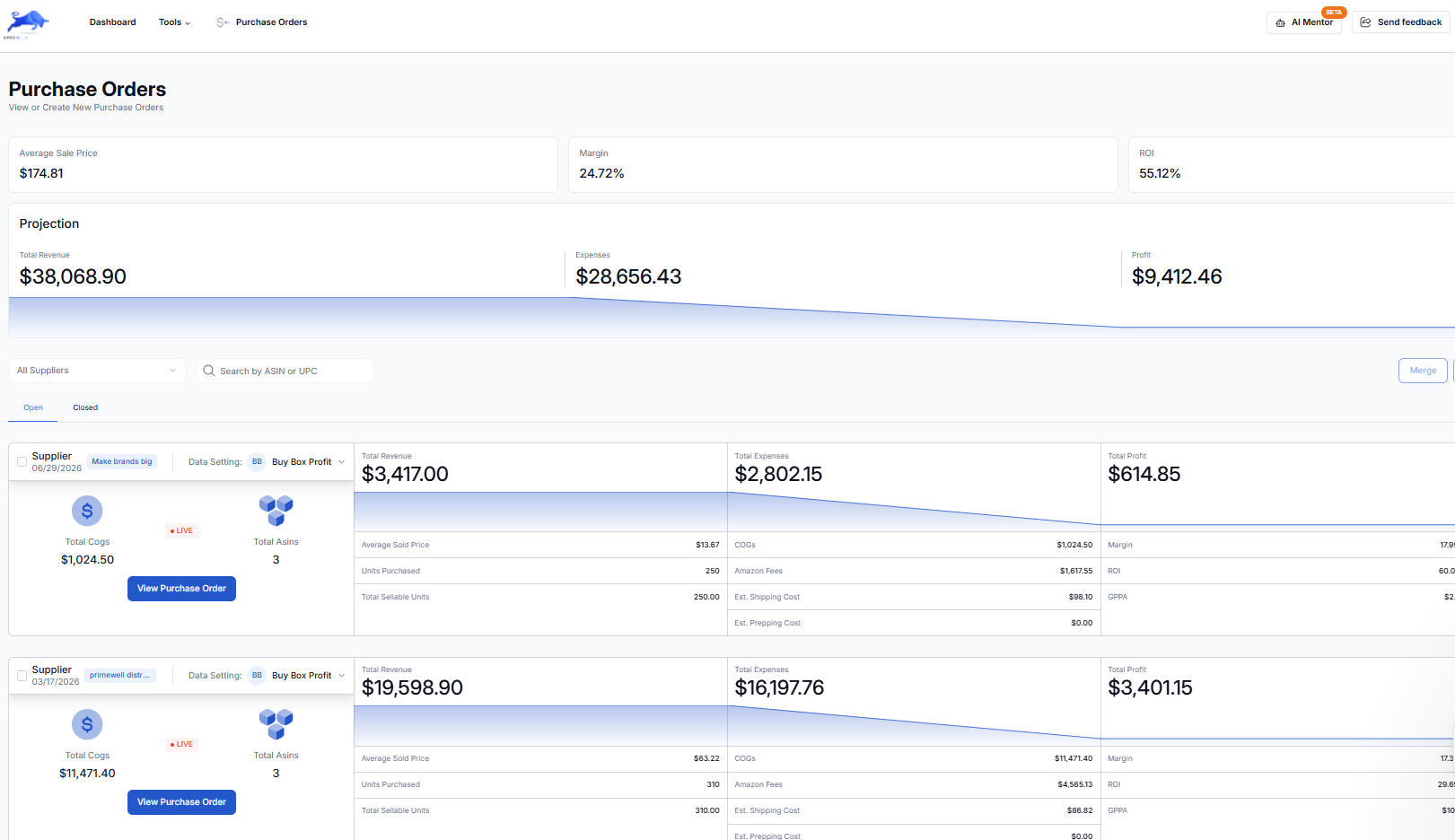
In Apex University's Purchasing lesson, Stef, who teaches the course, shows the habit inside Apex Blue. Once the supplier is paid, he submits the purchase order, which moves it to closed orders, and uploads the supplier's invoice to that order. Then he explains why. From Stef's lesson, at 30:39:
"If at any moment Amazon reaches out to you regarding a product authenticity claim, you can paste the ASIN right here."
Searching the ASIN brings up the purchase orders that contained it, each with its invoice, so the document Amazon wants is one search away instead of a dig through old email. If your closed orders list opens on a recent date range, widen it before you search, since Amazon can ask about invoices from up to a year back. Having the invoice to hand doesn't decide the appeal for you. Amazon still judges whether it meets the rules above, and whether the supplier checks out.
A weekly routine that keeps you ahead of warnings
None of these habits is hard. They protect you because they happen every week, not only after a warning arrives.
- Open the Account Health page once a week and read every new item, even when the score is green. Amazon's AHR FAQ encourages sellers to view the page regularly and address issues as they arise.
- Keep your emergency contact number current. Amazon says an Account Health specialist may call you, including during the three days after a critical violation, and asks sellers to keep the number under Emergency Notifications up to date.
- Answer verification and certification emails the day they arrive. The deadlines are short.
- Recheck your suppliers from time to time. Amazon's due diligence page suggests regularly monitoring a supplier's quality and compliance, and a distributor that could sell a brand last year may not be able to this year.
- Check the ASIN match and the condition before units ship to Amazon, especially when a distributor's product names differ from the listing.
- Keep review requests neutral and inside Amazon's tools.
- File the invoice with its purchase order the day it arrives.
Got a warning? What to do, by type
Warnings show up on the Account Health page, where Amazon lists next steps for each one. These are the first moves we'd make, and where to read more.
| What you got | First move | Read more |
|---|---|---|
| Product authenticity complaint | Find every order of that ASIN and its invoices, check them against Amazon's appeal invoice rules, then appeal from the Account Health page | The records section above |
| IP complaint (trademark, copyright or patent) | Read which right is claimed and who claimed it. Contact the rights owner if you have an agreement with them; appeal with an invoice for trademark or counterfeit claims about the product; edit the listing if the claim is about its content. Patent and copyright claims have their own steps on Amazon's IP policy page | Amazon's IP policy |
| Restricted product or approval warning | Fix or remove the listing, and confirm approval before you buy more | Ungating guide |
| Review or buyer messaging violation | Stop the requests or inserts involved and check every tool that sends messages for you | Review request guide |
| Verification or INFORM certification request | Respond inside the deadline in the email or on the Account Health page | Amazon's verification page |
| A notice that cites Section 3 | Find the specific violation behind it | Section 3 violations |
| Condition complaint | Check how those units were received, prepped and labeled | Prep centers |
Dispute or appeal? Amazon treats them differently. A dispute says the violation was detected in error, with evidence. An appeal accepts that a policy was broken and asks Amazon to forgive it because it wasn't intentional. Amazon's FAQ notes that a violation removed after a successful appeal, where you didn't dispute that it happened, may still count toward the repeat limit for 180 days. It also says that closing or deleting a listing does not remove a violation from the page.
Suspended? Start here
If your account is deactivated, Amazon's appeal help page says to go to Account Health, click Reactivate your account and follow the instructions, which may ask for a questionnaire, a quiz or documents, and to expect a reply within two days. Before you write a word, read the notification for the specific violation and pull the invoices and order records for every ASIN it names. Our suspension appeal guide walks through writing the plan of action.
Questions about Amazon account health
What is a good Account Health Rating on Amazon?
Amazon calls any score from 200 to 1,000 Healthy, and says a Healthy account is not at risk of deactivation under the policies the score covers. New accounts start at exactly 200, and the number climbs as you fulfill orders without open violations.
Does the order defect rate count FBA orders?
Amazon's order defect rate help page has said ODR only applies to seller-fulfilled orders. That page needs a sign-in and we have not rechecked it, so look at your own Account Health page. If you ship some orders yourself, keep those under the 1% target. For FBA orders, Amazon handles fulfillment and the delivery promise.
How long does a violation stay on the Account Health page?
Amazon says violations can be removed after 180 days, or sooner when a dispute or appeal succeeds, a rights owner retracts an IP complaint, or you take the corrective action it asks for. If the account is deactivated because of its rating, the violations stay on the page until you address them.
Can an account with a Healthy rating still be suspended?
Yes. Amazon says it may deactivate an account immediately, whatever the score, if it suspects fraudulent, deceptive, illegal or otherwise harmful activity, or if you break a policy that the rating does not cover.
How do I raise my Account Health Rating?
Address every open violation on the Account Health page, by appeal or by dispute if Amazon made an error, starting with the most severe. Fulfilled orders add points too, and violations older than 180 days stop counting.
Every guide in this part
- Amazon Section 3 violations: what they mean for resellers and what to doWhat Section 3 of Amazon's Business Solutions Agreement covers, the triggers that hit resellers, the documents to gather and how the appeal works.Read
- Amazon suspension appeal: how to write a plan of actionHow Amazon's appeal process works, the three parts of a plan of action, the documents to gather by suspension type, and when to get professional help.Read
Apex University comes with a free Apex account: nine lessons, no card.
Start Apex UniversityPick the plan that fits your monthly Amazon sales.
Starter, $149 a monthUp to $10K/mo in revenue
Start my 7-day trial on Starter7 days free, then $149 a month, plus tax where applicable. Card required, nothing charged until day 8. Cancel any time before then.
Pro, $299 a monthUnlimited
Start my 7-day trial on Pro7 days free, then $299 a month, plus tax where applicable. Card required, nothing charged until day 8. Cancel any time before then.
Sources
- Account Health Rating program policy, Amazon Seller Central
- Account Health Rating: frequently asked questions, Amazon Seller Central
- Policies included in Account Health Rating, Amazon Seller Central
- Order Defect Rate, Amazon Seller Central
- Order Performance program policy, Amazon Seller Central
- Amazon Services Business Solutions Agreement, Amazon
- Amazon anti-counterfeiting policy, Amazon Seller Central
- Intellectual property policy, Amazon
- Invoice requirements for appealing a policy violation, Amazon Seller Central
- Select reliable suppliers with due diligence, Amazon Seller Central
- Selling policies and seller code of conduct, Amazon Seller Central
- Restricted products, Amazon Seller Central
- Seller identity verification, Amazon Seller Central
- About the INFORM Consumers Act, Amazon Seller Central
- Appeal an account deactivation or listing removal, Amazon Seller Central
Some of Amazon's pages need a Seller Central sign-in to read, and we have not yet checked their current wording for this version of the page. If Amazon's page and this guide disagree, Amazon's page is the one that counts.
What is my real profit? When do I reorder? Why is my payout lower?