Brand-direct wholesale on Amazon: how to pitch a brand
Brand-direct wholesale means buying from the brand itself instead of a distributor. Brands say yes to resellers who protect their price, keep listings stocked and accurate, and buy steadily. Pitch with proof: what you found on their Amazon listings and your plan to fix it. Amazon won't enforce exclusivity for you, so don't promise it or rely on it.
- Brand direct usually comes after some order history with distributors. A brand's price isn't automatically lower than a distributor's, because distributors buy far more than you do.
- Brands worry about falling prices, sellers they don't know, stockouts and messy listings. A pitch that shows you've looked at their listings, and how you'd help, gets read.
- A letter from the brand and the Reseller role in Brand Registry are how you show you're authorized. Neither one removes anyone else from the listing.
- Amazon's staff have said Amazon won't step in to enforce exclusive distribution agreements. Exclusivity is a promise between you and the brand, so read it carefully on both sides.
- Keep your side of the deal: follow the pricing policy, stay in stock, sell new units on the existing listings, and report to the brand regularly.
Brand direct sits in two places on the Amazon wholesale roadmap. It's a sourcing move (stage 5), because the brand becomes your supplier. And it's a growth move (stage 10), because most sellers get there once they already buy from a few distributors and reorder the same products every month.
This guide starts where finding brands to wholesale ends. You have a brand you want, you've checked that it sells, and now you want to buy from the brand itself. The emails you'll send live in our distributor and brand email templates. This page is about everything around them: what the brand is weighing, how to show you're worth a yes, and which promises to make and avoid.
What brand direct means, and when it's worth it
In brand-direct wholesale, you open an account with the company that owns the brand and buy from it, instead of buying the same products from a distributor. Amazon's own guide for wholesale sellers names both routes as the right places to buy.
So brand direct isn't a different business model. It's the same wholesale business with one link taken out of the chain. Here is what changes.
| Buying from a distributor | Buying from the brand | |
|---|---|---|
| Who you deal with | A sales rep who handles many brands | Someone at the brand, often in sales or ecommerce |
| Range | Many brands on one price list | One brand, sometimes its full range |
| Price | Set by the distributor, often one list for everyone | Varies. Not always lower, as the next quote explains |
| Minimums | Often a dollar minimum across the whole order | Can be higher for one brand, sometimes by case or pallet |
| Paperwork | Invoices from the distributor | Invoices from the brand itself |
| Authorization | A distributor can't authorize you for the brand | The brand can write you a letter and give you a selling role |
| What they ask of you | Pay on time | Pay on time, and look after their price and listings |
The price row surprises people. In Apex University, Stef explains why the brand is not automatically the cheapest place to buy:
"Most people would believe that working directly with the manufacturer is going to give you access to the best prices. That is not all true. Just because you're not buying the same type of volume that redistributors are doing."
From Stef's lesson (Finding Suppliers, at 2:34)
Large distributors buy by the truckload to supply stores across the country. A brand may give them better pricing than it gives a single Amazon seller. So the reasons to go direct are usually something other than a lower unit cost.
Brand direct tends to be worth it when:
- You already sell the brand. It reorders well through a distributor, and buying direct could add the products your distributor doesn't carry, better availability or a closer relationship.
- The brand is small or mid-sized. Smaller brands often sell to retailers themselves, or through a short list of partners, so there may be no distributor to go through at all.
- The brand only approves its own sellers. Some brands are open only to their authorized resellers. When your applications for a brand keep getting denied, an Amazon staff member on the US Seller Forums put it simply: "Your best bet is to work with the brand directly and get their approval to sell the product on Amazon."
- Its listings need help, and it knows it. A brand that sees its prices sliding or its products going out of stock has a reason to talk to you.
It's usually not the place to start when:
- You have no order history yet. Brands, like distributors, want to see a real business that buys on time. Our guide to opening a wholesale account covers the basics, and the suppliers guide covers where distributors are.
- It's a household name. Big manufacturers sell to big distributors. Ask them who they supply, not for an account of your own.
What brands want from an Amazon reseller
Read your pitch from the brand's side of the desk. A brand that sells through stores, its own website and Amazon has to keep all of those channels working at once. When something goes wrong on Amazon, the brand hears about it from its customers and its other retailers, not from Amazon.
These are the problems a brand is usually trying to solve, and what you can offer for each one.
| What worries the brand | What it looks like on Amazon | What you can offer |
|---|---|---|
| Falling prices | The Buy Box price drifts below what its stores charge, and its other retailers complain | Follow its pricing policy, with a price floor set in your own tools |
| Sellers it doesn't know | Offers from sellers it never sold to, so it can't tell where their stock came from | Buy only from the brand or its distributors, keep every invoice, and tell the brand your seller name |
| Stockouts | The listing runs out, sales rank slips, and shoppers buy a competing product | Steady orders, planned around the brand's lead time |
| Messy listings | Duplicate listings, old packaging photos, wrong variations or titles | Sell only on its existing listings and report problems for the brand to fix |
| Unhappy customers | Damaged, expired or used units sold as new, and the reviews that follow | Careful prep, in-date stock, new and sealed units only |
| Time | Amazon is a job of its own, and a small brand may have nobody for it | You do the Amazon work and send the brand a short report |
Notice what's missing from that list: "a seller who will buy a lot." Volume matters, but a brand that has been burned by price drops may prefer a smaller, steady buyer it trusts over a big one it doesn't.
Questions a brand is likely to ask you
There's no standard list, and every brand asks differently. But expect questions along these lines, and have short, true answers ready before the first call.
- Who are you, how long have you been selling, and in which categories?
- Where do you sell: only Amazon, or your own website and other marketplaces too?
- Do you ship through Fulfillment by Amazon or yourself?
- How will you price our products, and will you follow our pricing policy?
- How much would you buy, and how often?
- Do you sell our products now? If so, where do you buy them?
- What would you change on our listings?
- Is your account in good standing?
If you sell the brand today through a distributor, say so and name the distributor. It answers the "where does your stock come from" question before it's asked, and it shows you already buy their products the right way. And if you're unsure how your account looks from Amazon's side, our account health guide covers what Amazon measures.
Before you pitch: look at the brand's Amazon listings
The strongest thing you can bring to a brand is something it may not have looked at closely: what is actually happening on its own listings. That takes an hour or two, and it turns your pitch from "please sell to me" into "here is what we found, and here is what we'd do."
| What to check | Where to look | What it tells the brand |
|---|---|---|
| How many products it has on Amazon, and which sell | The brand's name under a listing title, or a search filtered by the brand | Where the money is, and which listings matter most |
| How many sellers share each top listing | The list of other offers on each listing | Whether its products are crowded with sellers it may not know |
| Whether Amazon is the seller | "Ships from" and "Sold by" (or "Shipper / Seller") on each listing | Whether the brand also sells to Amazon itself (ask, don't assume) |
| Where the price is heading | The Buy Box price against its 90-day history, in Keepa or a similar tool | Whether prices are sliding |
| Stockouts | Gaps in the offer count and the sales rank history | Sales it lost while nobody had stock |
| Listing problems | Duplicate listings, old photos, wrong sizes or variations | Fixes only the brand can make, and an easy first win for you |
| Ratings and recent reviews | The listing's reviews, sorted by most recent | Whether damaged or expired units are hurting the brand |
Then do three things on your own account before you send anything:
- Check Add a Product. Search a few of the brand's products in Seller Central's Add a Product tool and look for "Show limitations." Our page on gated brands explains why approval for the same brand can differ between accounts.
- If it's gated, note the letter. Read what the application asks for. When it wants a letter from the brand, that letter goes on your list of things to ask the brand for later.
- Work out the most you can pay. Know your highest cost per unit for the return you want, so a price list from the brand can be judged in minutes. The profit calculator has a mode for exactly that.
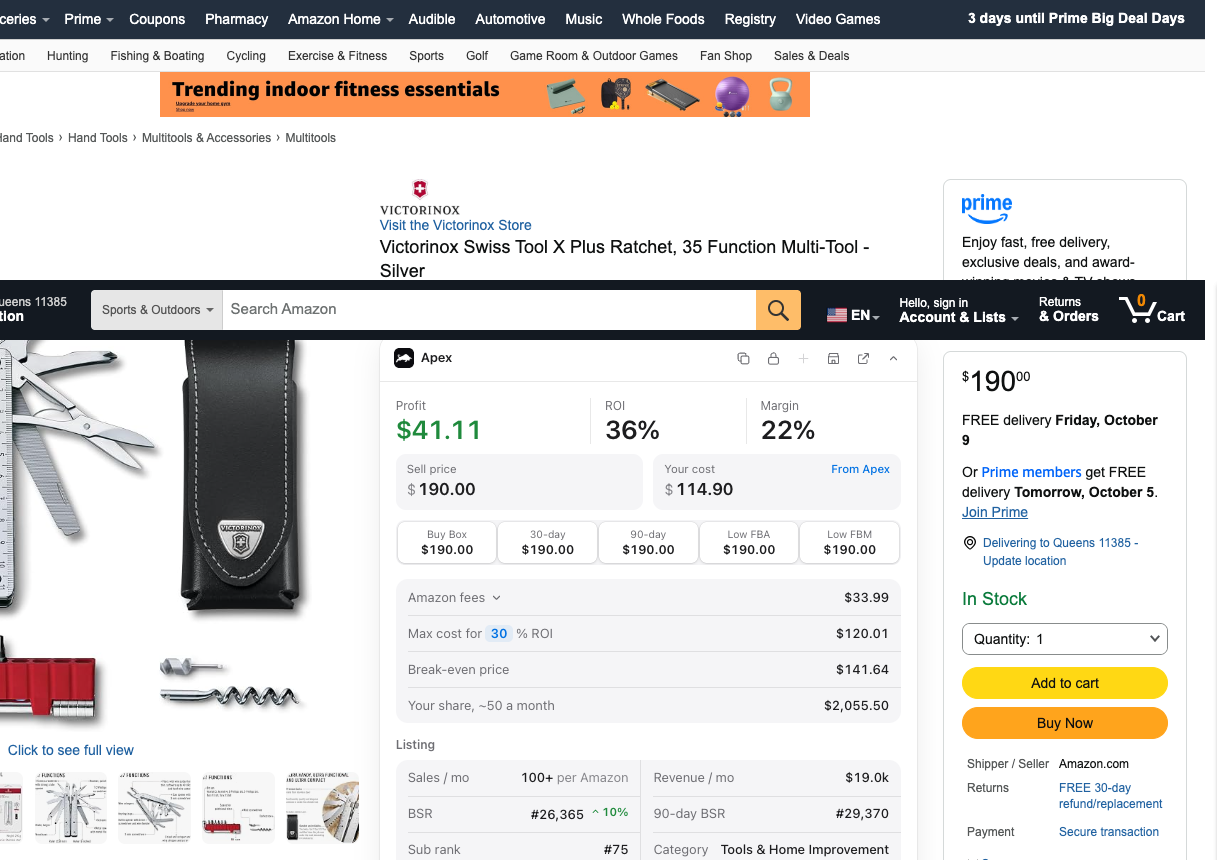
If you use Apex for Amazon Sellers, the product panel puts the Buy Box price next to its 30 and 90 day averages and the lowest FBA and FBM offers, which is the "where is the price heading" row of the table at a glance. It's free to install, and its numbers open when you finish Apex University.
For the whole brand at once, Brands in Apex Green shows how many products a brand has on Amazon, how many sellers sit on each listing and how many of them use FBA, and the share of its listings Amazon sells. Open the brand to see each product with its rank, estimated monthly sales and Buy Box price. The walkthrough below shows it in use.
Apex University's Brand Reverse Search lesson covers the same idea of working from a brand to its products. It was recorded on an older version of the software, so the screens look different today.
Turn what you found into three findings
Pick the three findings that matter most to the brand and write each one as a fact plus a fix. Keep it factual and polite. You're describing the listing, not accusing anyone, so never call another seller's stock fake or unauthorized: you can't know that, and the brand may supply them.
Fill in the brackets from what you saw yourself, and leave out any row you can't back up. Three true findings beat ten guesses.
The pitch, step by step
The first email is short on purpose. Use Template 3 in our email templates, the one for asking a smaller brand to sell to you, and when the brand asks whether you sell on Amazon, Template 4 in the same guide is the reply. What follows is the sequence around those emails.
- Find the right person
Look on the brand's website for pages called wholesale, retailers, "become a dealer" or "where to buy," and check the footer for a sales address. If nothing is listed, the people you want usually have titles like sales manager, ecommerce manager or national accounts. A contact form is fine, but follow it with an email to a person.
- Send the short first email
Who you are, that you sell on Amazon, which of their products you want, and one question: do they sell to retailers directly, or through distributors? Nothing else yet. If they work through distributors, ask which one, and buy there.
- Send your one-page profile when they reply
A reply is your cue to send more. Attach a single page with the profile below and your three findings. One page gets read. A ten-page deck usually doesn't.
- Get on a call
Brand accounts are often opened on a call rather than by email. Use the call to answer their questions and to ask yours (the checklist further down). Take notes, and confirm what you agreed in writing the same day.
- Start with a first order, not a contract
Ask for their price list, minimum order and payment terms, and offer a realistic first order. Exclusivity, special pricing and big commitments can wait until you have a sales record with the brand.
- Ask for the letter and the Reseller role once you're buying
After a few orders, ask for a letter of authorization and, if the brand is in Brand Registry, the Reseller role. Our letter of authorization guide covers what the letter should say, and Template 8 in the email guide asks for both.
The first order step is where patience pays. In the Finding Suppliers lesson, Stef says this about suppliers in general, and it holds for brands too:
"Some companies, they're not going to give you the best prices from the beginning. You have to spend a few dollars. You know, you have to spend and buy one or two POs before they even take you seriously."
From Stef's lesson (Finding Suppliers, at 21:24)
- Your legal business name, address, website and the name you sell under on Amazon
- How long you've sold, in which categories, and roughly how many brands you carry
- How you fulfill: FBA, your own shipping, or a prep center
- How you source: only from brands and their authorized distributors, with every invoice kept
- Your commitments: their pricing policy, new and sealed units only, their existing listings only
- Your three findings from their listings, each with a fix
- What you're asking for: an account, a price list, their minimum order and payment terms
- Who else do you supply for Amazon, and do your distributors allow marketplace sales?
- Do you sell to Amazon directly, so Amazon is a seller on your listings?
- Do you have a pricing policy, such as a minimum advertised price, and what happens when someone breaks it?
- Are you enrolled in Brand Registry? Would you assign us the Reseller role once we're buying?
- Are any of your products in Amazon's Transparency program? If so, how do we get codes?
- What are your minimum order, payment terms and lead time?
- How do you handle damaged or short shipments, and returns?
- How much notice do you give before a price change?
- Do you have a reseller agreement for us to read?
Keep a record of every brand you pitch, who you spoke to and what they said. A spreadsheet works. In Apex Blue, each supplier gets a record on the Vendors page with its rep, minimum order, payment method and lead time, and Pipeline tracks each one from first contact to approved or denied.
Names and categories are public, and contacts open with a subscription.
What Amazon will and will not enforce for you
Sellers get this part wrong in both directions. Some expect an authorized-reseller deal to clear the listing for them. Others don't realize how much a brand can still do through Amazon without them. Here is the split, with Amazon's own pages.
| Amazon will | Amazon won't |
|---|---|
| Hold every seller to its anti-counterfeiting policy | Enforce a brand's exclusive distribution agreement with you |
| Give a brand in Brand Registry tools to report suspected infringement and policy violations | Remove sellers of genuine products because you're authorized and they aren't |
| Let the brand give you the Reseller role | Treat a broken distribution agreement as intellectual property infringement |
| Limit who can create new listings for a Brand Registry brand | Let an authorized reseller skip Amazon barcodes |
| Check Transparency codes on enrolled products | Enforce a brand's pricing policy for it, as far as we can find |
What Amazon will do
Authenticity applies to everyone on the listing, you included.
A brand enrolled in Brand Registry gets more say over its listings. Amazon's Brand Registry page says the program puts protections in place to help safeguard a brand's product information, and that its Report a Violation tool is where a brand reports suspected intellectual property infringement, store policy violations and regulatory compliance concerns. Amazon's guide to Brand Registry roles adds that selling roles, Reseller included, don't come with protection tools like Report a Violation. Reporting is the brand's job, not yours.
Brand Registry is also where a brand can mark you as one of its sellers.
So ask for Reseller, not Brand Representative. The role matters most when one of the brand's products needs a new listing, because the same guide says a selling role gives a seller the ability to create new listings for a brand.
If the brand uses Transparency, that is a hard line you can only cross with the brand's help.
So without codes from the brand, you can't sell its protected products in those stores. Ask about it on the first call.
What Amazon won't do
The key sentence comes from an Amazon staff post on the US Seller Forums about reporting violations through Brand Registry. Under the heading on exclusive distribution, Dougal_Amazon wrote:
"Amazon respects a manufacturer's right to enter into exclusive distribution agreements for its products. However, violations of such agreements do not constitute intellectual property rights infringement. As the enforcement of these agreements is a matter between the manufacturer and the retailers, it would not be appropriate for Amazon to assist in enforcement activities."
An exclusive deal is a contract between you and the brand. Amazon isn't a party to it, and it won't remove another seller because the brand promised you exclusivity.
Being authorized doesn't change who else may sell, either. In a thread about letters of authorization, Amazon community manager Topher_Amazon wrote that "Amazon is an open marketplace where authorization isn't required to sell genuine products." Other sellers with genuine units, bought from a distributor or anywhere else, can stay on the listing next to you.
Authorization doesn't change your labels either.
The notice draws the line at the Brand Representative role, so the Reseller role doesn't exempt you: plan on an Amazon barcode on every unit. Our FNSKU label guide covers what that means.
Pricing is the last piece. We haven't found an Amazon page that gives brands a way to make other sellers follow a minimum advertised price. In practice, a brand's main lever is who it supplies: a reseller who breaks its pricing policy can lose the account. Our guide to Automate Pricing and repricers covers the tools on your side of that.
What this adds up to: being a brand's authorized seller gets you a supply line, paperwork you can show Amazon when it asks, and a relationship. It doesn't get you a lock on the listing.
Exclusivity promises to be careful with
Exclusivity often comes up in brand conversations, in one direction or the other. Some of these promises are fine. Some cost money. A few can't be kept by anyone.
Promises a brand may make you
- "You'll be our only Amazon seller." What the brand can actually do is stop supplying other Amazon sellers itself, and ask its distributors to do the same. Stock already out there keeps selling, and as the quote above shows, Amazon won't remove genuine offers for you. Ask which distributors carry the brand and what their terms say about marketplaces.
- "We'll get the other sellers removed." Be careful here. Amazon's staff have said a broken distribution agreement isn't intellectual property infringement, so it isn't grounds for an infringement complaint. If a brand plans to clear its listings with complaints, you, as the seller it chose, can end up in the middle of them. Our guide to IP complaints on Amazon shows what they look like from the seller's side.
- "Exclusive for a year." Ask what happens at the end, what ends it early, and whether it covers the whole range or only some products.
If a brand wants help with infringement reports, Amazon's roles guide describes a separate Registered Agent role, for third parties a trademark owner authorizes to report suspected IP violations for the brand. Being a brand's reseller doesn't make you its agent, and reporting sellers you compete with is a position most resellers are better off avoiding.
Promises you may be asked to make
- A minimum yearly purchase. Buy what sells, not what a target says. Offer a forecast instead of a promise, and tie it to your sales. Our guide to negotiating with distributors covers this trade.
- An advertising budget. Some brands want their resellers to run ads on Amazon. Work out whether the margin can carry it before you agree.
- Following their minimum advertised price. A common ask, and often the reason they'll sell to you. Set your floor so you can keep it.
- Agreeing on prices with other sellers. Don't. Following a brand's own pricing policy is one thing; coordinating prices with other resellers is another. Amazon updated its Seller Code of Conduct in 2021, and Amazon's announcement says it prohibits "any form of conduct that violates price fixing laws."
- Not selling competing brands. Possible, but it limits your business for one brand's sake. Agree to it only for a good reason and a limited time.
- "Cleaning up" the listing. You can promise to sell well on it. You can't promise to remove anyone.
- How long it lasts, how either side can end it, and the notice period
- What happens to your unsold stock if it ends: a sell-off period or a buyback
- What exclusivity covers exactly: which products, which marketplaces, which countries, and what the brand will actually do
- The pricing policy, how the brand checks it, and what happens if it's broken
- Minimum orders or yearly purchases, and what happens if you miss them
- Payment terms, and who pays for damaged or short shipments
- Whether the brand will give you the Reseller role and a letter of authorization
- How Transparency codes reach you, if the brand uses them
- Who may change the listing content, and how you report a problem
Any agreement with exclusivity, minimum purchases or penalties is worth an hour of a lawyer's time before you sign. It costs far less than a year of commitments you can't meet.
Protecting price and listing quality
Once you're buying direct, your job is to be the seller the brand hoped for. Most of it is ordinary good selling, done consistently.
Price
- Write the brand's pricing policy down, with the date you received it. If it has a minimum advertised price, that's your floor whenever it's higher than your profit floor.
- Set floors in your pricing tools. Amazon's Automate Pricing page says you can manage your margins by setting a minimum price and an optional maximum price. In Apex, Apex Gold sets floors from your own cost and Amazon's fees and shows MAP status by brand. The repricer is part of the Pro plan.
- Don't chase a lower price below the policy. Winning the Buy Box for a day by breaking the policy can cost you the account. Our Buy Box guide explains what else decides who wins it.
- Know your real cost. Freight, prep and Amazon's inbound fees all come out of the margin. Our guide to landed cost adds them up.
Stock and listings
- Stay in stock. A stockout is one of the first things a brand sees. Plan reorders around its lead time with a reorder point, and tell the brand early if a big order is coming.
- Sell on the existing listings. Never create a duplicate. If something is wrong with the content, send the brand the ASIN and what's wrong, since it's the one who can fix it.
- Send only new, sealed, in-date units. Check expiry dates on arrival and follow Amazon's prep requirements, so no customer gets a damaged or short-dated unit with the brand's name on it.
- Ask for reviews the way Amazon allows. Amazon's Request a Review button sends buyers Amazon's own message asking for a review, and our guide to automating review requests covers how to send it on every eligible order.
Report to the brand
A short monthly note does more for the relationship than any pitch. It takes a few minutes, and it gives you a reason to talk before there's a problem.
- Units sold of their products this month, and what you have in stock
- When your next order is coming, and its rough size
- The Buy Box price on their main listings, and whether it held
- Listing problems you found, with the ASINs
- Review or return patterns worth knowing about
- Anything you need from them: a price list update, codes, a role, a fix
Keep the brand's record up to date as you go: who your contact is, its minimums and lead time, and what you paid on each order. A price change you catch on the purchase order is one you can raise with the brand before it comes out of your margin.
Questions about buying direct from brands
Is buying direct from the brand cheaper than buying from a distributor?
Not always. Large distributors buy far more than a single Amazon seller, and a brand may price them accordingly. Brand direct is usually worth it for something else: products your distributor doesn't carry, steadier supply, the brand's authorization, or a brand that has no distributor at all.
Do brands sell directly to small Amazon sellers?
Many smaller and mid-sized brands do, especially ones that already sell to independent stores. Large manufacturers usually don't, and will point you to their distributors instead. Either answer is useful: a no from a big brand often comes with the names of the distributors it supplies.
Can a brand make me its only seller on Amazon?
Not by itself. A brand can stop supplying other Amazon sellers and give you the Reseller role in Brand Registry, but Amazon's staff have said Amazon won't enforce exclusive distribution agreements, and sellers with genuine units can keep selling. Treat exclusivity as a supply promise, not a listing lock.
When should I ask a brand for exclusivity?
After you have a sales record with the brand, and even then, ask for things the brand controls: priority supply, the full range, early notice of new products. Asking for exclusivity in the first email tells the brand you're thinking about yourself, not about their listings.
What should I send a brand besides the first email?
A one-page profile: your business details, how you sell and source, the commitments you'll keep, and three findings from the brand's Amazon listings with a fix for each. Send it when the brand replies, not with the first email, and keep it to one page.
Apex University comes with a free Apex account: nine lessons, no card.
Pick the plan that fits your monthly Amazon sales.
Starter: 7 days free, then $149 a month, plus tax where applicable. Card required, nothing charged until day 8. Cancel any time before then.
Pro: 7 days free, then $299 a month, plus tax where applicable. Card required, nothing charged until day 8. Cancel any time before then.
Sources
- How to find wholesalers, Amazon
- Guide to Brand Registry roles, Amazon
- Amazon anti-counterfeiting policy, Amazon Seller Central
- ASIN creation policy, Amazon Seller Central
- Transparency, Amazon
- Commingling practices will end effective March 31, 2026 (US notice), Amazon Seller Forums (News_Amazon)
- Automate Pricing, Amazon
- Top 3 mistakes when reporting a violation through Brand Registry (Dougal_Amazon), Amazon Seller Forums
- Letter of Authorization Requirements (Topher_Amazon), Amazon Seller Forums
- Selling Applications Denied (Manny_Amazon), Amazon Seller Forums
- Updates to Selling Policies and Seller Code of Conduct (News_Amazon), Amazon Seller Forums
- Amazon Brand Registry, Amazon
Some of Amazon's pages need a Seller Central sign-in to read, and we have not yet checked their current wording for this version of the page. If Amazon's page and this guide disagree, Amazon's page is the one that counts.
We build software for Amazon sellers who buy from wholesale suppliers, and we write these guides from what we see in that work.
Who can authorize you to sell a brand on Amazon, what a letter of authorization should cover, how to ask for one, and what it does not do for you.