Is Amazon FBA worth it? An honest answer for each business model
Amazon FBA is worth it if you treat it as a business: enough cash for a first order with some held back, steady time every week, and the habit of checking fees before you buy. It isn't passive income, and it's a poor fit for money you'll need back soon. For most beginners, wholesale is the model that holds up.
- Wholesale is the model most likely to be worth it for a beginner, because a supplier who sold you a product once can sell it to you again.
- In Amazon's own results, independent sellers sold about six in every ten paid units in its stores worldwide, in each quarter from early 2025 to mid-2026. FBA isn't dead. The careless version of it is.
- Fees decide most outcomes. Run a real product through the calculator on this page before you buy anything.
- Money comes back slowly and in pieces. You pay your supplier first, and each unit's money reaches you only after it sells, waits out Amazon's hold and is paid out.
- You can test the whole model for the cost of one small supplier order, and you don't need any software at this stage.
We make software for Amazon wholesale sellers, so you might expect us to say yes, it's worth it, for everyone. We won't. Amazon FBA works well for some people and badly for others, and the difference is mostly money, time and patience. It's rarely about finding one magic product.
This page answers the question for each way of selling on Amazon, shows what Amazon's fees take from a sale, walks through how long your money is gone, and says who shouldn't start. Then it shows how to test the whole thing for the price of one small order.
A quick test
If you only read one part, read this table.
| It's likely worth it if | It's likely not worth it if |
|---|---|
| You can pay for a first order and still keep money aside for a reorder | Every dollar you have would go into the first order |
| You can give it steady hours every week, for months | You want income that runs without you |
| You'll check fees and demand on every product before you buy | You'd rather pick products by feel |
| You're fine sharing listings with other sellers and competing on price and stock | You want to own a brand you can sell one day |
| You'll keep invoices and follow Amazon's rules on every unit | You're looking for a way around approvals |
If the left column sounds like you, FBA wholesale is a reasonable bet. If the right column does, that's not a judgment on you. It just means this business would frustrate you, and it's better to find that out before you spend anything.
Worth it by model
FBA is how your orders get shipped, not what you sell, and every model below can use it. So whether it's worth it depends a lot on where your stock comes from. Here's each model in a sentence. The full comparison, with Amazon's rule for each, is in the business models table in our guide to reselling on Amazon.
- Wholesale: worth it for most beginners who can cover a supplier's opening order, because the products already sell and the same supplier can restock them.
- Online arbitrage: worth it as a low-cost way to learn listings, fees and prep, but good deals rarely repeat, and a retailer's receipt isn't the manufacturer or distributor invoice Amazon asks for when a product needs approval.
- Retail arbitrage: the same trade in physical stores, with more driving and scanning for every unit you find. Good for learning, hard to grow.
- Private label: worth it only with real capital, marketing skill and patience, because you have to create the demand yourself. In lesson one, Stef calls it the riskier of the two models for someone without Amazon experience (The Game, 3:29). Wholesale vs private label compares the two in depth.
- Dropshipping from other retailers: not worth it, and not allowed. Amazon's guide to reselling says retail-to-retail drop-shipping is prohibited.
- Liquidation pallets: not worth it for an Amazon business either, because the same guide says auctions and liquidation are not valid sources of supply.
FBA or ship orders yourself?
The other half of the question is the FBA part. With Fulfillment by Amazon, you send your stock to Amazon's warehouses, and Amazon stores, picks, packs and ships each order and handles customer service and returns. Amazon says FBA products "are also eligible for free, two-day shipping through Prime." The alternative is shipping orders yourself, which sellers call FBM (fulfilled by merchant).
FBA isn't the cheap option. You pay a fulfillment fee on every unit, which Amazon bases on the product's price, weight and dimensions, and monthly storage for the space your units take up. That's why many new sellers keep stock at home instead. Stef, who teaches Apex University, puts it this way:
"Doing FBM is something that I see lots of new sellers do because they have a bit more control over their money."
That's from Stef's lesson The Game, 6:39. His view is that fear of storage fees is the wrong reason to ship from home. Storage is charged every month, so you can't avoid it entirely, but buying quantities that sell through keeps it small, and he says learning to buy the right amount is part of what the course covers. His reasons to start with FBA are in the same passage: Prime eligibility, which he says brings more sales than shipping yourself, and not having to pack every order.
Shipping yourself can still make sense for big, heavy or slow-selling items where FBA fees would take too much of the price. To compare, run the product through the calculator further down twice: once with Amazon's FBA fulfillment fee, and once with that fee at zero and your own packing and postage under "Other costs."
Is Amazon wholesale profitable after fees?
It can be, product by product, and the fees hold most of the answer. Amazon takes its share of every sale before you see a dollar, and on a reseller's thin margins that share decides whether a product is worth buying.
Nobody can tell you what the business as a whole will make, and anyone who promises a number is guessing or selling something. What you can do is check each product before you buy it.
The first thing out of every sale is the referral fee: a percentage of the total price, or a per-item minimum where the category has one, whichever is higher. The rate depends on the category, and Amazon referral fees by category has Amazon's full table. Here's one row, for a category many wholesale sellers buy in.
| Category | Referral fee | Minimum |
|---|---|---|
| Beauty, Health, and Personal Care | 8% at $10.00 or less; 15% above $10.00 | $0.30 |
- A product's fee category may not be the same as the category shoppers see in the Amazon store.
Source: Selling plans and pricing, Amazon
The rest of what comes out of an FBA sale:
- The FBA fulfillment fee. Charged per unit and set by size, weight and price. FBA size tiers and fulfillment fees explains how Amazon sorts products.
- Storage. Charged monthly for the space your units take, with extra charges on stock that sits unsold too long. See Amazon FBA storage fees.
- The inbound placement fee. Charged on shipments into Amazon, depending on how your shipment is split. See the inbound placement fee.
- Your selling plan. Amazon charges either a monthly subscription or a fee per item sold. The Amazon FBA fees guide covers both plans and every fee above.
- Your own costs. What you paid the supplier, prep and labels, shipping to Amazon, and returns.
The fastest way to know whether this business can work for you is to price a real product. Pick something you could actually buy, find its Amazon price and its FBA fulfillment fee in Amazon's Revenue Calculator, and put both in the calculator below. The "Most I can pay" mode turns the question around: it tells you the highest supplier cost that still reaches the return you want.
Profit and most-you-can-pay calculator
Per unit, from Amazon's FBA fulfillment fees page or Amazon's Revenue Calculator. Leave it empty if you ship orders yourself.
Per unit.
Per unit: storage, returns, ads, anything else you count.
Per unit.
Type what you pay the supplier.
Runs in your browser from Amazon's published US fee tables. Nothing you type is sent anywhere.
How do you decide whether a result is good enough? In his Purchasing lesson, Stef sets three filters on a sample supplier list (Purchasing, 5:38 to 6:25). It's one example from his lesson, not Amazon's rule and not a promise of results:
- A minimum profit of $1.50 per unit. He adds that "even two dollars we can do", and that the number is up to you.
- A minimum return of 20% on what you pay.
- A sales rank between 1 and 90,000.
He picked $1.50 because that supplier sells inexpensive personal care items that can sell hundreds of units a month. Sales rank means different things in different categories, so treat that last number as a first filter, not a universal line. The wholesale profit margins guide goes deeper on what a healthy margin looks like.
What it costs to start
There's no single number, because your biggest cost is set by your suppliers, not by Amazon. A distributor's minimum opening order and its case packs decide most of your first spend. How much it costs to start Amazon wholesale works through budgets. Here's the shape of it.
| Cost | When you pay it | What sets the amount |
|---|---|---|
| Amazon selling plan | Monthly, or per item sold | Amazon's pricing page |
| Business setup | Mostly at the start | Your state, if you form an LLC or need a resale certificate |
| First inventory | Often before the goods ship, for a new account | The supplier's minimum order and case packs |
| Prep, labels and shipping to Amazon | Every shipment | Your prep center's rates, or your own time |
| Amazon's fees | Taken from each sale, plus storage and placement | Amazon's fee tables |
| A cash reserve | Held back from the start | Enough to reorder while you wait to be paid |
| Software | Optional at the start | Nothing to buy at this stage |
The prep line changed in 2026. Amazon stopped prepping and labeling US FBA shipments on January 1, 2026 (Amazon's developer notice). And for inventory shipped on or after March 31, 2026, resellers who aren't a brand's Brand Representative must put Amazon barcode stickers on their units, even when the product already has a manufacturer barcode (Amazon's announcement). So labeling is now your job or your prep center's, and it belongs in your cost per unit.
Some setup costs are smaller than people fear. The IRS says you never have to pay a fee for an employer identification number (IRS), and many distributors ask for a resale certificate before they'll sell to you.
The line people skip is the reserve. Your first order's money comes back slowly, as each unit sells, so if every dollar goes into that order, you can't restock the products that turn out to work. The next section shows why.
Apex University comes with a free Apex account: nine lessons, no card.
How long until money comes back
Usually longer than people expect, and not all at once. This is the part of FBA that catches new sellers off guard, so here's one cycle, step by step. It's an illustration, not a forecast. How fast your units sell decides most of it.
| Step | What happens | Where your money is |
|---|---|---|
| 1. You pay the supplier | A new account often pays before the order ships. Payment terms tend to come later, once you have a history with the supplier. | With the supplier |
| 2. The goods travel | To you or to your prep center. | In transit |
| 3. Prep and ship to Amazon | As a reseller, you put an Amazon barcode on every unit, then the shipment goes to the warehouses Amazon assigns. | In your shipment, plus prep and shipping costs |
| 4. Amazon receives it | Units become available to buy once Amazon has received them. | On Amazon's shelves |
| 5. Units sell | One order at a time, at whatever pace the product and the other sellers allow. | Turning into sales |
| 6. Each sale is held | Amazon typically reserves the money from each delivered order for seven days, so buyers can inspect what they bought. | In your Amazon balance |
| 7. Amazon pays out | In general, Amazon settles seller accounts every two weeks, and a transfer can take up to five business days to reach your bank. | In your bank |
| 8. You reorder | Ideally before you sell out, which often means before the first order has fully paid you back. | With the supplier again |
Steps 6 and 7 come from Amazon's own page on how seller payments work. Three things follow from the cycle.
- Your first order comes back in pieces. Each unit's money returns when that unit sells and clears the hold. The slowest product on the order decides when the last of it is back.
- A good product makes you pay again early. If something sells well, you'll want to restock before it runs out, and that usually means paying the supplier before the first order has finished paying you. That's what the reserve is for.
- Slow sellers cost you twice. They hold your cash, and they keep paying storage while they wait.
The delivery-date hold, which Amazon calls DD+7, is explained in more detail in the payouts section of our rule changes page.
Who should not start
Some people are better off not starting, at least not yet. That's you if any of these are true.
- You need the money back soon. If the cash you'd put in is rent, a loan payment or your emergency fund, the cycle above makes this a bad fit.
- You want passive income. FBA hands the packing and shipping to Amazon. It doesn't hand over the sourcing, the supplier emails, the reorders or the numbers. Be wary of anyone selling an Amazon store that runs itself. In July 2025, the FTC announced that the operator of FBA Machine is permanently banned from selling business opportunities. The FTC alleged the scheme falsely promised that people could make money running online storefronts with AI-powered software.
- You won't check the numbers. Fees, demand and competition decide every product. If you'd rather buy on instinct, the fees will find you.
- You want to build something you can sell. In lesson one, Stef is plain that a store of other companies' brands won't become an asset you can sell for much later on (The Game, 4:36). If owning a brand is the goal, look at private label with your eyes open.
- You're hoping to get around the rules. Approvals, supplier invoices and an Amazon barcode on every unit are part of the job now. The account health guide explains what's at stake when a seller cuts corners.
If none of those stopped you, the hard parts are still worth knowing in advance. The challenges of Amazon wholesale takes them one at a time.
Is Amazon FBA dead?
No, and Amazon's own numbers say so. Each quarter, Amazon reports what share of the paid units sold in its stores worldwide came from independent sellers rather than from Amazon itself. Here are the six quarters from early 2025 to mid-2026, from the table in its second quarter 2026 results.
| Quarter | Share of paid units sold by independent sellers | Growth in all paid units, year over year |
|---|---|---|
| Q1 2025 | 61% | 8% |
| Q2 2025 | 62% | 12% |
| Q3 2025 | 62% | 11% |
| Q4 2025 | 61% | 12% |
| Q1 2026 | 60% | 15% |
| Q2 2026 | 61% | 17% |
Amazon notes that both measures exclude Whole Foods Market. Its earlier releases are on its investor relations site.
So roughly six in every ten units sold in Amazon's stores come from independent sellers, and the total number of units keeps growing. Combine Q2 2026's 17% growth with the 62% and 61% shares for Q2 2025 and Q2 2026, and units sold by independent sellers grew by roughly 15% over the year before. That's our arithmetic on Amazon's rounded figures, not a number Amazon publishes.
These figures count every independent seller, brand owners and resellers, FBA and self-shipped alike. They show the marketplace isn't shrinking. They don't say that any one seller makes money.
What did change is the easy version. In 2026 alone, Amazon stopped prepping and labeling US FBA shipments, resellers had to start putting an Amazon barcode on every unit, and several FBA fees changed. Each change adds a little cost or work per unit, and that hurts the sellers who never knew their numbers. Amazon rule changes for resellers keeps the full list, each with Amazon's own source.
So when someone says FBA is dead, they usually mean the version where you could send in anything and work out the numbers later. That version is gone. The version where you buy proven products from real suppliers, and know your costs before you order, is still open to anyone willing to do the work.
How to test it cheaply first
You can find out whether this business suits you before you risk much. The cheapest test is a sequence, not a product.
- Learn the whole cycle first
Watch lesson one above, then the rest of Apex University. It comes with a free Apex account: nine lessons, no card. It costs you some evenings, not inventory.
- Price five real products on paper
Pick products you could actually buy from a real distributor. Run each one through the calculator above or the profit calculator, and hold them to a buying rule like Stef's. If none of the five works after fees, you've learned something important without spending a cent.
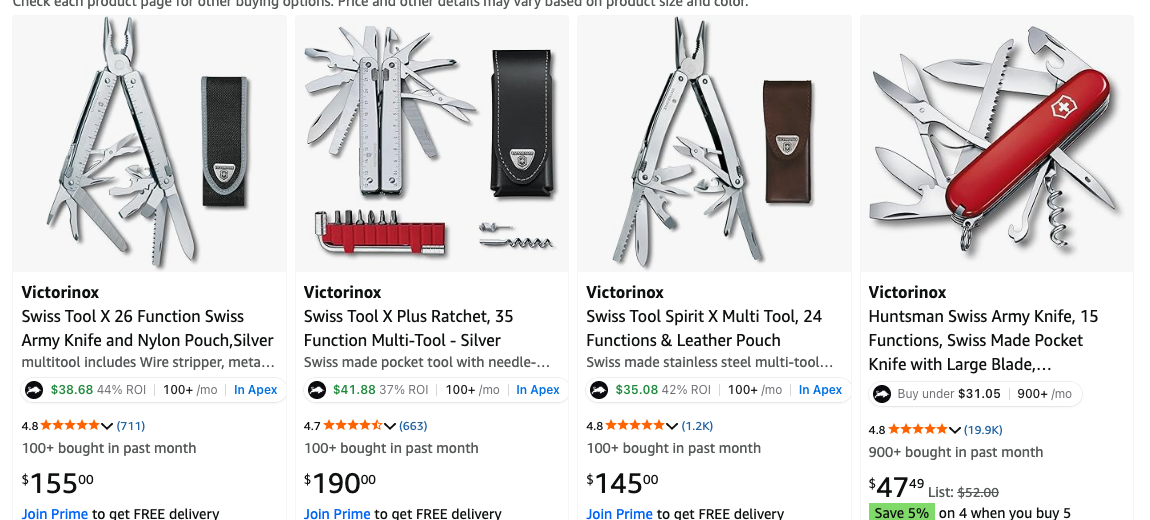
There's a shortcut once you've finished the course: the Chrome extension. It's free to install, and its numbers open when you finish Apex University. Under Amazon's own search results, it adds a badge to each product with its monthly sales (Amazon's figure where there is one, otherwise an estimate), and its profit and ROI when Apex knows your cost. When it doesn't, the badge shows the most you can pay for the return you want. The extension's page explains each number.
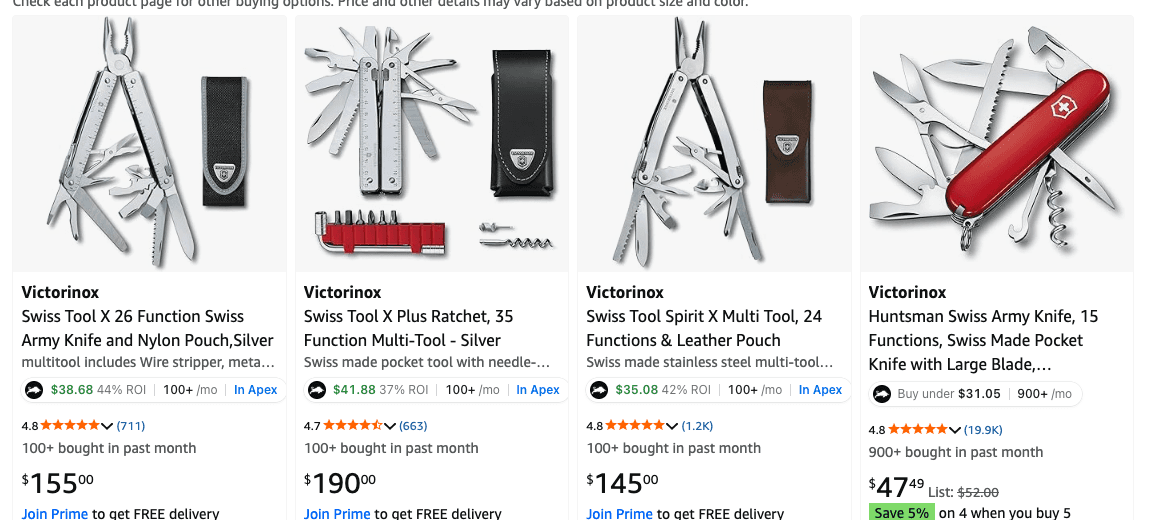
Badges under Amazon search results: profit and ROI where Apex knows your cost, and the most you can pay where it doesn't. - Check that you're allowed to sell them
Look up their categories on the gated categories list. A product that needs Amazon's approval isn't off limits, but it adds a step and paperwork, which the ungating guide walks through.
- Set up the basics that cost little
Get your EIN from the IRS, and a resale certificate from your state if your suppliers ask for one. How to open a wholesale account covers what distributors want to see before they say yes.
- Make the first order small and boring
One supplier, a few products that already sell steadily, and quantities you could sell through without stress. Your first wholesale order covers how many units to send.
- Keep score honestly
Write down what you paid, every fee, your prep and shipping costs, and the date each sale's money reached your bank. After one full cycle, you'll know whether it's worth it for you, which beats any article's answer, this one included.
When you're ready for the next step, the Amazon wholesale roadmap lays out every stage in order, and how to start Amazon wholesale is where the setup begins.
Questions about whether Amazon FBA is worth it
Is Amazon FBA worth it for a complete beginner?
It can be, if you start with wholesale, keep your first order small, and learn the fees before you buy. Beginners struggle most when they put all their money into one order or pick products by feel. Learning how the model works first costs you nothing but time.
Is Amazon FBA passive income?
No. Amazon handles storage, packing, shipping, customer service and returns, but you still find products, deal with suppliers, prep stock, reorder and watch your numbers. Be wary of anyone who sells an Amazon store as hands-off income.
Should I use FBA or ship orders myself when I start?
For most resellers, FBA, because FBA products are eligible for Prime shipping and you don't pack every order yourself. Shipping yourself can make sense for big, heavy or slow-selling items where FBA fees would take too much of the price. Price the same product both ways before you decide.
How long before Amazon FBA pays back my first order?
It depends almost entirely on how fast your products sell. Money comes back one unit at a time: Amazon typically holds each delivered order's money for seven days, and it generally settles seller accounts every two weeks. A first order of steady sellers pays back much sooner than one with slow products in it.
Apex for Amazon Sellers is free to install, and its numbers open when you finish Apex University. Create a free account, work through the lessons, then install it from the Chrome Web Store.
You don't need to pay for anything at this stage.
Sources
- Amazon quarterly results, Amazon Investor Relations
- Amazon.com announces second quarter results (Form 8-K, Exhibit 99.1), Amazon.com, Inc., filed with the SEC
- Selling plans and pricing, Amazon
- Fulfillment by Amazon, Amazon
- How Amazon seller payments work, Amazon
- Guide to reselling in Amazon stores, Amazon
- Commingling practices will end effective March 31, 2026 (US notice), Amazon Seller Forums (News_Amazon)
- SP-API changelog: US FBA prep and labeling services end, Amazon Selling Partner API
- How to find wholesalers, Amazon
- Get an employer identification number, IRS
- FTC Obtains Permanent Ban of E-Commerce Business Opportunity Scheme Operator, Federal Trade Commission
We build software for Amazon sellers who buy from wholesale suppliers, and we write these guides from what we see in that work.
How do I start? Do I need an LLC, an EIN and a resale certificate? How much money?