Amazon Section 3 violations: what they mean for resellers and what to do
Section 3 is the Term and Termination section of Amazon's Business Solutions Agreement. It lets Amazon suspend or close an account immediately on five grounds: an uncured breach, deceptive, fraudulent or illegal activity, harm to customers, sellers or Amazon, an Account Health Rating below its threshold, or the law. Your fix starts with the violation your notice names.
- Section 3 is the clause Amazon acts under, not the rule you broke. The policy and products behind it are in your notification and on the Account Health page.
- Amazon may hold your payouts after a Section 3 deactivation. A successful appeal releases them, and there is a separate funds appeal after 60 days.
- For resellers, watch authenticity complaints, supply chain document requests, untraceable stock, business details that no longer match, and related accounts.
- Most of them are answered with ordinary records: supplier invoices tied to each ASIN, proof of where the stock came from, and business documents that match Seller Central.
- Don't open a second account, and never send an edited document.
A message saying your account was deactivated under Section 3 is one of the most stressful things a seller can open. It's also one of the least specific. This guide explains what the clause actually says, what it does to your account and your money, the triggers that catch resellers of genuine goods, and the documents to pull together before you answer.
Everything below about Amazon's rules comes from the US agreement and Amazon's own help pages, linked below. Most of them sit inside Seller Central and need a sign-in, and someone signed in has not yet rechecked their current wording for this version of the page. Amazon changes these pages, so its links are the final word, and our editorial policy explains how we check them. For the bigger picture of how Amazon grades sellers, start with our guide to Amazon account health.
What Section 3 of Amazon's Business Solutions Agreement says
Everyone who sells on Amazon accepts the Amazon Services Business Solutions Agreement (BSA) when they register. It's the contract between you and Amazon, and the US version sits on Amazon's Seller Central help site. Section 3 is titled Term and Termination. It covers how the agreement starts and how it ends, and the agreement points back to it by number elsewhere: the section on changes to the agreement, for example, sends you to Section 3 if you'd rather leave than accept a change.
In plain words, Section 3 says four things:
- Either side can end it. You can close your account at any time by telling Amazon. Amazon can end the agreement for convenience with 30 days' notice.
- Amazon can act at once on five grounds. The clause says Amazon "may suspend or terminate your account or this Agreement immediately" when it determines that one of them applies.
- Amazon owes you a notice, with limits. It says it will promptly tell you about a suspension or termination, by email or in Seller Central, with the reason and any options to appeal. It can leave that out when it believes telling you would hinder an investigation into deceptive, fraudulent or illegal activity, or help you get around its safeguards.
- Your obligations outlast the account. You stay responsible for orders placed before the termination, and for liabilities that arose before it or because of it.
The five grounds for immediate suspension
| Ground | What the agreement says, in our words | Where a reseller might run into it |
|---|---|---|
| (a) Uncured breach | You materially broke the agreement and didn't fix it within 7 days of a cure notice. Amazon can shorten or skip the 7 days when the breach exposes it to liability toward a third party. | A document request or policy warning left unanswered past its deadline |
| (b) Deceptive, fraudulent or illegal activity | The account has been used for it, or Amazon's controls identify that it may be | Identity details that can't be verified, edited invoices, counterfeit findings, stolen goods |
| (c) Harm | Your use of Amazon's services has harmed, or Amazon's controls identify that it might harm, other sellers, customers or Amazon's legitimate interests | Customer complaints that items are fake, used or not as described |
| (d) Account Health Rating | Your rating fell below Amazon's published threshold for deactivation | Policy violations that pile up faster than you resolve them |
| (e) The law | Amazon is required to act by law | Verification and certification under the INFORM Consumers Act, which Amazon's help page ties to deactivation |
Two details do a lot of work here. Amazon acts when it determines that a ground applies, and grounds (b) and (c) include what its controls identify an account may do, not only what it has done. So a seller who meant no harm can still receive a Section 3 notice, and the way back is evidence.
The agreement promises you a reason, not a letter, so your notice may not say which ground applies. Read the right-hand column as a guide to where to look, not as Amazon's own mapping.
What the rest of the agreement adds
Three other parts of the BSA matter here. Section 1 requires the information you give Amazon to match your business name, or the name of someone legally authorized to act for the business. Section 2 lets Amazon withhold payments while it sees a risk of returns, claims or policy violations, and keep them permanently if your account, or any other account you have operated, was used for deceptive, fraudulent or illegal activity, such as selling counterfeit or stolen goods. And the agreement defines "you" to include your affiliates: any business that controls yours, that yours controls, or that is under common control with yours.
Is it a Section 3 violation or a policy violation?
Sellers say "Section 3 violation", and so does the title of this page, but strictly speaking you can't violate Section 3. It's the clause Amazon uses to act. What you violated, or what Amazon believes put its store at risk, sits underneath it in one of Amazon's policies.
Most problems start smaller. A policy violation shows up on your Account Health page and can cost points on your Account Health Rating, and many are resolved right there, by an appeal, a dispute or a fix to a listing. A Section 3 notice is the step where the account itself is deactivated. Amazon's funds disbursement eligibility policy uses exactly that language: a deactivation under Section 3 of the Business Solutions Agreement.
So the first question isn't what Section 3 is. It's which policy, and which products. Three places answer it:
- The notification email. Amazon's appeal questionnaire guidance says the products under review are listed at the bottom of your original notification.
- Performance Notifications in Seller Central, which keeps a copy of each notice.
- The Account Health page, where each violation has its own appeal steps.
What a Section 3 deactivation does to your account and your money
Selling stops. A deactivated account can't sell, and that includes the stock sitting in FBA. We couldn't find an Amazon help page that says what happens to those units while an appeal is open, so ask Account Health Support before you request a removal.
Payouts can be held. Amazon's funds disbursement eligibility policy says that after a Section 3 deactivation it may hold the funds in your account if it decides your actions may create risks for Amazon or others. It can use them to cover what you owe: returns and refunds, A-to-z claims, inventory removal costs, outstanding fees and damages.
Reinstatement releases them. The same policy says that if an appeal gets the account reinstated, the funds are paid out on your normal disbursement schedule.
There is a separate route to the money. If the appeal fails, or you decide not to appeal, Amazon says you can appeal for withheld funds by emailing disbursement-appeals@amazon.com any time after 60 days from the deactivation. It may ask for documents about your identity, payment methods or supply chain, and says it may keep the funds permanently if it finds deceptive, fraudulent or illegal activity, or can't confirm who you are.
Inventory found to be fake can be destroyed. Amazon's anti-counterfeiting policy says that if you sell inauthentic products, it may dispose of them in its fulfillment centers at your expense. Its stolen goods policy says the same about stolen stock.
Your other accounts are in scope. The anti-counterfeiting policy extends suspension to related accounts, and Amazon's seller code of conduct says that if any of your accounts isn't in good standing, Amazon may deactivate all of them until they all are.
The Section 3 triggers that hit resellers
Wholesale and arbitrage sellers deal in genuine brand-name goods, so the risk is rarely the product itself. It's the gap between what Amazon asks you to show and what you can actually show. These are the gaps we'd look at first, each tied to the Amazon page behind it.
Authenticity complaints and test buys
A customer, a rights owner or Amazon's own checks question whether an item is genuine. Amazon's anti-counterfeiting policy puts the work on you: every seller must source and sell only authentic products, and must hand over records about authenticity when Amazon asks for them. Our account health guide explains how Amazon ranks these complaints, including why a counterfeit finding from one of its test buys is the most serious kind.
For a reseller, the trap is genuine stock you can't prove. An invoice without the supplier's phone number and website, or one that lists only the supplier's internal item codes, can fall short of Amazon's invoice requirements for appeals. If you buy a brand through a distributor, our guide to the letter of authorization explains what proof of that chain looks like.
Supply chain document requests
This is the one that surprises wholesale buyers. Amazon's Responsible Sourcing documentation page says a sourcing request can ask for invoices or receipts that:
- show where the products were produced or manufactured;
- reflect your sales of the product across all Amazon marketplaces over the last 365 days;
- show the full supply chain, with contact details for your suppliers and for the original manufacturer, whom Amazon may contact.
The key line is the next one. Amazon says your documents should trace the products back to the original manufacturer even when you didn't buy from the manufacturer, which can mean asking your supplier for its own invoices. If you miss the deadline, Amazon says it may remove the listings, suspend your ability to list, and withhold payments.
The practical lesson is to ask before you buy. When you open a distributor account, ask which brands it buys directly and whether it can show it if Amazon ever asks. Our guides to opening a wholesale account and emailing distributors include those questions.
Stolen or untraceable stock
Amazon's stolen goods policy bans products obtained through theft or any other illicit means at any point in the supply chain, and it says plainly that as a seller you must validate your supply chain. The BSA names stolen goods next to counterfeits as illegal activity that can cost you your payouts. A lot sold far below what authorized distributors charge, by someone who won't issue a business invoice, is the kind of deal to walk away from.
Identity and business details that no longer match
Amazon verifies your identity, address and business when you register, and it keeps checking. Its seller performance review page says a deactivated account may have to go through a review after you change the address you registered with, your bank account details or your phone number, or when your credit card is invalid or out of date, and it notes that the list isn't complete. To pass the review, at least one of your documents must show a name and address that match what's in Seller Central.
Many resellers also fall under a federal law, and the bar is lower than it sounds. Amazon's INFORM Consumers Act page says it covers sellers who, in any continuous 12 months of the previous 24, made 200 or more separate sales of new or unused consumer products and had $5,000 or more in gross revenue. Those sellers must have their details verified whenever they change and certify them at least once a year, with 10 days to certify once the certification page is opened. Miss a verification or certification deadline and Amazon says it may withhold payments or deactivate the account.
Stef, who teaches Apex University, builds this in before a seller buys anything. In the Checklist lesson, he starts with two-step verification on the seller account. From Stef's lesson, at 2:42:
"This is a very serious business. Treat it like it's a bank account."
Then he has new sellers get a business bank account, send Amazon's payouts to it and pay suppliers from that same account. One business name and one bank account across Seller Central, your supplier accounts and your invoices means every document Amazon asks for tells the same story.
Related accounts
Amazon's seller code of conduct allows one Seller Central account per region unless you have a legitimate business need for a second one and all your accounts are in good standing. Its examples of a legitimate need: you own several brands run as separate businesses, you manufacture products for two distinct companies, or Amazon recruited you into a program that needs a separate account. If any of your accounts isn't in good standing, Amazon says it may deactivate all of them.
Amazon doesn't publish how it decides that accounts are related, and we won't guess. What the agreement does say is that "you" includes your affiliated businesses, and that deceptive activity on any other account you have operated can cost you your payouts. If you've ever run another selling account, under any business, know its status before it surprises you.
Edited or self-made documents
Amazon's invoice requirements reject sales quotes and pro forma invoices, invoices you issued yourself or that come from a supplier that appears to be your own business, files that were digitally altered, and editable formats such as Excel or Word. Under the anti-counterfeiting policy, an edited document is a violation in its own right.
That's why tidying up an invoice, even to fix a supplier's typo, is a bad idea. Ask the supplier to reissue it. A complaint you could have answered with a real invoice can turn into a question about deception, which is where ground (b) comes in.
Listings and reviews
Amazon's code of conduct counts a second detail page for a product that already has one as misleading information, so match your units to the existing ASIN and check the brand, size, count and variation before you ship. It also bars any attempt to influence reviews. Our guide to automating review requests covers the requests Amazon allows.
Apex University comes with a free Apex account: nine lessons, no card.
Documents to gather for a Section 3 appeal
Whatever the trigger, an appeal is won or lost on documents. Here's what each trigger calls for, built from the agreement and the Amazon pages above.
| If the notice is about | Gather | Amazon's page |
|---|---|---|
| Product authenticity or a counterfeit complaint | Supplier invoices for each listed ASIN, dated within the 365 days before the notice and covering your sales and stock of it; a letter of authorization if you have one | Invoice requirements |
| A supply chain or sourcing request | The same invoices, plus documents that trace the stock to the original manufacturer, with contact details for your suppliers and the manufacturer | Responsible Sourcing |
| Stolen or untraceable stock | Invoices, proof of payment, the supplier's business details and how you checked them | Stolen goods policy |
| Identity, address or bank details | A government photo ID, business documents, and a bank statement or utility bill showing a name and address that match Seller Central | Seller performance review |
| INFORM verification or certification | Whatever the email or the Account Health page asks for, inside its deadline | INFORM Consumers Act |
| A related account | The code of conduct page doesn't list documents for this. Have your business formation documents ready, and a plain account of any other selling account you've run | Seller code of conduct |
| A rating below the threshold | An answer, with documents, for each open violation on the Account Health page | Our account health guide |
Amazon's invoice rules also cover the file itself: the supplier's full contact details, clear product identifiers such as UPCs, a PDF or image upload in Seller Central, never an email. Our guide to the records to keep from every order walks through each rule.
A documents checklist for a Section 3 appeal
This is our checklist, built from Section 3 of the agreement and the Amazon pages above. It is not a list Amazon publishes, and your notice may ask for less or for more.
- The notification, saved as a PDF, with every ASIN and order ID it lists
- For each ASIN, every supplier invoice from the 365 days before the notice, exactly as the supplier issued it (prices may be removed, nothing else changed)
- Your units sold and in stock for each ASIN over the same 365 days, so you can show the invoices cover them
- Proof of payment for each invoice, ideally from the business bank account on file with Amazon
- Each supplier's legal name, address, phone number and website, with a note of how and when you checked them
- Anything that traces the stock to the manufacturer: a letter of authorization, or your supplier's own invoices from the brand
- Your business documents, such as formation papers and your EIN letter, in the same name and address as Seller Central
- A recent bank statement or utility bill showing that name and address
- A list of any other selling account you have operated, with its status
- A dated timeline of what happened and every change you have made since
How Stef keeps invoices one search away
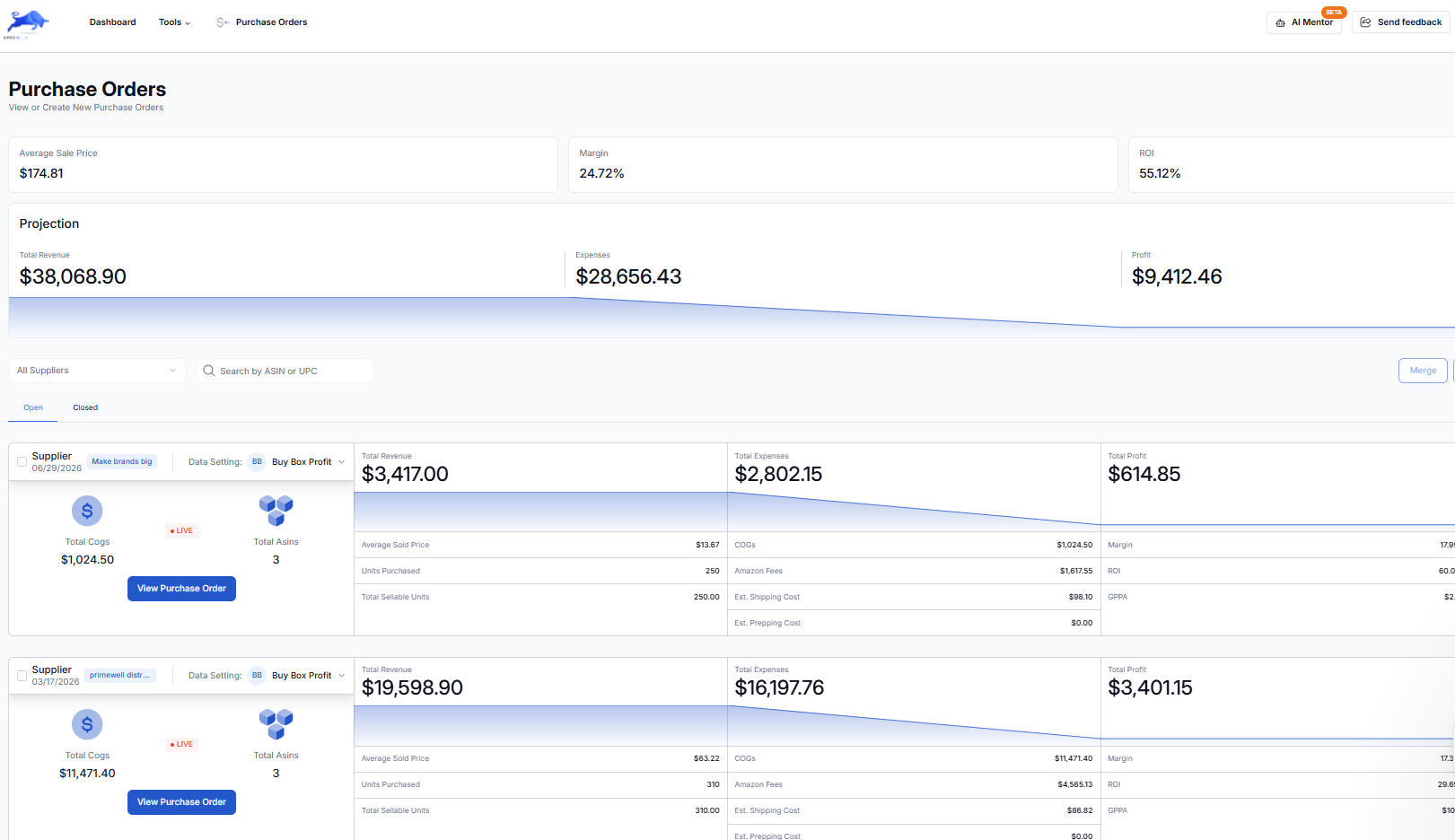
In Apex University's walkthrough of the software, Stef shows this habit inside Apex Blue. When a purchase order is paid and submitted, it moves to closed orders, and that's where he attaches the supplier's invoice. If Amazon later raises an authenticity claim, a search for the ASIN brings up the orders that contained it, with the supplier and the invoice. Then he adds the part no software can do for you. From Stef's lesson, at 19:44:
"You just have to make sure that you buy from authentic suppliers."
An invoice on file doesn't decide an appeal for you. Amazon still judges whether it meets the rules above, and whether the supplier checks out.
What to do after a Section 3 notice
- Read the notice, then find the policy underneath
Read the email and its copy in Performance Notifications, then open the Account Health page. Write down the policy named and every ASIN or order listed. Even when the notice is vague, that list of products is your map.
- Don't open another account or flood Amazon with submissions
A new account while one is deactivated runs straight into the one-account rule above. Amazon's seller performance review page also asks sellers not to resubmit documents before it has had time to review them, and not to keep sending inaccurate ones.
- Pull the documents for every ASIN
Work through the checklist above. Check each invoice against Amazon's invoice requirements before you upload anything, and ask suppliers to reissue anything that falls short. Never edit one yourself.
- Write a factual appeal
Amazon's appeal guidance asks for clear, factual writing with no emotional language. Explain every issue and its root cause (Amazon's examples include unverifiable suppliers and quality control), list the actions you've taken with their dates, and include evidence for every product under review, with the ASINs and supplier names highlighted. Our suspension appeal guide goes deeper on writing it.
- Submit it from Account Health
On the Account Health page, click Reactivate your account and follow the steps, which can include a questionnaire, acknowledging a violation, a quiz or documents. Amazon's appeal page says to expect a reply within two days, and to use View Appeal on Account Health if it asks for more.
- Ask for held funds separately if you need to
If the appeal doesn't succeed, or you choose not to appeal, the funds disbursement policy gives you the separate route described above, from 60 days after the deactivation.
Getting help. Some sellers bring in a lawyer or an appeal consultant, especially when large sums are held or Amazon alleges counterfeits or fraud. It helps to know that the BSA includes a binding arbitration agreement and a class action waiver, which shapes what a dispute with Amazon can look like, and that nobody outside Amazon can promise a reinstatement. Whoever helps you, read every document before it's submitted, because an edited document is a violation in its own right.
How to make a Section 3 notice less likely
The full weekly routine lives in our account health guide. These are the habits that line up with the five grounds:
- Buy from suppliers who can show where their stock comes from. Our wholesale suppliers guide covers how to check a distributor before you buy.
- File every invoice with its purchase order the day it arrives, searchable by ASIN, including every reorder. Amazon wants invoices dated within the 365 days before its notice that cover what you sold in that time, so the invoice from your first order two years ago won't help.
- Keep one business identity: the same legal name, address and bank account on Seller Central, your supplier accounts and their invoices. Treat every verification email as a deadline.
- Run one selling account, and never edit an invoice.
- Check approvals before you buy gated or restricted products, using our gated categories list.
The ungating connection. The invoices that get you approved in a category and the invoices that answer an authenticity complaint come from the same habit: buying from real distributors and keeping their paperwork. Amazon's rules for the two are different, though, so check each against its own page. Our guide to ungating invoice requirements covers the approval side, the ungating guide covers the whole process, and our rule changes log tracks the Amazon changes that affect resellers.
Questions about Amazon Section 3 violations
Is every Amazon policy warning a Section 3 violation?
No. Most warnings are policy violations listed on the Account Health page. Many count against your Account Health Rating, and you answer them there. Section 3 is the clause Amazon uses when it suspends or deactivates the account itself, which can follow when violations go unresolved or the rating drops below Amazon's deactivation threshold.
Which part of Section 3 was my account suspended under?
The agreement promises a reason and your options to appeal, not the lettered ground, and it lets Amazon hold back even the reason when it believes sharing it would hinder an investigation. Your appeal doesn't need the letter. It needs to answer the policy and the products named in the notification, in Performance Notifications and on the Account Health page.
Will Amazon release my funds after a Section 3 deactivation?
If an appeal gets the account reinstated, Amazon says the funds are paid out on your normal schedule. If not, you can appeal for them separately by email any time after 60 days from the deactivation. Amazon may use held funds to cover refunds, claims, fees and damages, and may keep them if it finds fraud or can't confirm your identity.
Does a Section 3 deactivation affect my other seller accounts?
It can. The agreement defines "you" to include your affiliated businesses, and Section 2 lets Amazon keep payouts if any other account you have operated was used for deceptive, fraudulent or illegal activity. Amazon's code of conduct adds that if any of your accounts isn't in good standing, it may deactivate all of them. So the route back is the appeal, not a new account.
Can Amazon close my account without a violation?
Yes. Section 3 lets Amazon end the agreement for convenience with 30 days' notice. Immediate suspension needs one of the five grounds, but two of them cover what Amazon's controls identify an account may do, so a confirmed violation isn't always required.
You don't need to pay for anything at this stage.
Sources
- Amazon Services Business Solutions Agreement, Amazon
- Funds disbursement eligibility policy, Amazon Seller Central
- Amazon anti-counterfeiting policy, Amazon Seller Central
- Responsible Sourcing documentation request requirements, Amazon Seller Central
- Amazon Stolen Goods Policy, Amazon Seller Central
- Seller identity verification, Amazon Seller Central
- Seller performance review, Amazon Seller Central
- About the INFORM Consumers Act, Amazon Seller Central
- Selling policies and seller code of conduct, Amazon Seller Central
- Invoice requirements for appealing a policy violation, Amazon Seller Central
- Appeal an account deactivation or listing removal, Amazon Seller Central
- Complete an appeal questionnaire to reinstate selling privileges, Amazon Seller Central
Some of Amazon's pages need a Seller Central sign-in to read, and we have not yet checked their current wording for this version of the page. If Amazon's page and this guide disagree, Amazon's page is the one that counts.
We build software for Amazon sellers who buy from wholesale suppliers, and we write these guides from what we see in that work.
How Amazon's appeal process works, the three parts of a plan of action, the documents to gather by suspension type, and when to get professional help.